Catalog No.
RWK27301
Species reactivity
Apis mellifera (Honeybee)
Host species
Human
Isotype
IgG1
Clonality
Monoclonal
Applications
ELISA
Target
Hyaluronidase, Hya, Allergen Api m II, Hyaluronoglucosaminidase, Api m 2
Concentration
1 mg/ml
Endotoxin level
Please contact with the lab for this information.
Purity
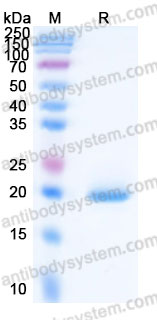
>95% as determined by SDS-PAGE.
Purification
Protein A/G purified from cell culture supernatant.
Accession
Q08169
Form
Liquid
Storage buffer
0.01M PBS, pH 7.4.
Stability and Storage
Use a manual defrost freezer and avoid repeated freeze-thaw cycles. Store at 4°C short term (1-2 weeks). Store at -20°C 12 months. Store at -80°C long term.
Clone ID
21E11#
Note
For research use only.
Separation and isolation of the hyaluronidase and phospholipase components of bee-venom and investigation of bee-venom-human serum interactions., PMID:4960297
The specificity of the anti-hyaluronidase developed in beekeepers serum against bee venom hyaluronidase., PMID:4166652
Allergy to insect stings. II. Phospholipase A: the major allergen in honeybee venom., PMID:54382
Allergens in bee venom. I. Separation and identification of the major allergens., PMID:977862
Allergenic potency of bee antigens measured by RAST inhibition., PMID:1016291
Allergens in bee venom II. Two new high molecular weight allergenic specificities., PMID:401840
Allergens in Hymenoptera venoms. IV. Comparison of venom and venom sac extracts., PMID:856902
Studies of chemically modified honeybee venom. I. Biochemical, toxicologic and immunologic characterization., PMID:6178698
Changes in the levels of anti-phospholipase A2 and hyaluronidase antibodies during bee venom immunotherapy., PMID:6646134
Antibodies to purified bee venom proteins and peptides. I. Development of a highly specific RAST for bee venom antigens and its application to bee sting allergy., PMID:6601672
Antibodies to purified bee venom proteins and peptides. II. A detailed study of changes in IgE and IgG antibodies to individual bee venom antigens., PMID:6619452
Bee keepers' IgG and IgE antibody responses to bee venom studied by means of crossed radioimmunoelectrophoresis., PMID:6205790
Histamine release from peripheral blood leukocytes with purified bee venom allergens: effect of hyperimmune beekeeper plasma., PMID:2471697
Analysis of differing patterns of cross-reactivity of honeybee and yellow jacket venom-specific IgE: use of purified venom fractions., PMID:2499550
Immunoblot analysis of IgE and IgG antibodies to honey bee venom: cross sectional and sequential studies in bee sensitive subjects., PMID:1807261
Biochemical properties and study of antigenic cross-reactivity between Africanized honey bee and wasp venom., PMID:8081540
Occupational allergy to bumblebees: allergens of Bombus terrestris., PMID:11692115
Antibody binding to venom carbohydrates is a frequent cause for double positivity to honeybee and yellow jacket venom in patients with stinging-insect allergy., PMID:11742287
Regulation of hyaluronidase activity by alternative mRNA splicing., PMID:12084718
Individual hymenoptera venom compounds induce upregulation of the basophil activation marker ectonucleotide pyrophosphatase/phosphodiesterase 3 (CD203c) in sensitized patients., PMID:12403934
Identification by immunoblot of venom glycoproteins displaying immunoglobulin E-binding N-glycans as cross-reactive allergens in honeybee and yellow jacket venom., PMID:15005742
Sol i 1, the phospholipase allergen of imported fire ant venom., PMID:15753912
Prevention of allergy by a recombinant multi-allergen vaccine with reduced IgE binding and preserved T cell epitopes., PMID:16206231
Identification of a B-cell epitope of hyaluronidase, a major bee venom allergen, from its crystal structure in complex with a specific Fab., PMID:17374540
[Cross-reactivity to honeybee and wasp venom]., PMID:18265954
Dissecting cross-reactivity in hymenoptera venom allergy by circumvention of alpha-1,3-core fucosylation., PMID:19896717
Reassessing the role of hyaluronidase in yellow jacket venom allergy., PMID:19910026
Identification of a novel melittin isoform from Africanized Apis mellifera venom., PMID:20472009
Hyaluronidase and hyaluronan in insect venom allergy., PMID:21597301
High sensitivity of CAP-FEIA rVes v 5 and rVes v 1 for diagnosis of Vespula venom allergy., PMID:22277201
Hyaluronidase from the venom of the social wasp Polybia paulista (Hymenoptera, Vespidae): Cloning, structural modeling, purification, and immunological analysis., PMID:23305623
[Cross reactions between Hymenoptera venoms from different families, genera and species]., PMID:25234625
Sensitization to Api m 1, Api m 2, and Api m 4: association with safety of bee venom immunotherapy., PMID:25736542
IgE cross-reactivity of phospholipase A2 and hyaluronidase of Apis dorsata (Giant Asian Honeybee) and Apis mellifera (Western Honeybee) venom: Possible use of A. mellifera venom for diagnosis of patients allergic to A. dorsata venom., PMID:28712914
Routine clinical utility of honeybee venom allergen components., PMID:30176296
Sensitization to Api m 1, Api m 2, and Api m 4 in Japanese beekeepers who had experienced systemic reactions to honeybee stings., PMID:30279045
A Novel Apilic Antivenom to Treat Massive, Africanized Honeybee Attacks: A Preclinical Study from the Lethality to Some Biochemical and Pharmacological Activities Neutralization., PMID:33466223
Diagnosis and treatment of Hymenoptera venom allergy: S2k Guideline of the German Society of Allergology and Clinical Immunology (DGAKI) in collaboration with the Arbeitsgemeinschaft für Berufs- und Umweltdermatologie e.V. (ABD), the Medical Association of German Allergologists (AeDA), the German Society of Dermatology (DDG), the German Society of Oto-Rhino-Laryngology, Head and Neck Surgery (DGHNOKC), the German Society of Pediatrics and Adolescent Medicine (DGKJ), the Society for Pediatric Allergy and Environmental Medicine (GPA), German Respiratory Society (DGP), and the Austrian Society for Allergy and Immunology (ÖGAI)., PMID:37854067
Sensitization against medical hyaluronidase in patients with confirmed hypersensitivity against hymenoptera species and its clinical implications., PMID:39005205
Venom Component Allergen IgE Measurement in the Diagnosis and Management of Insect Sting Allergy., PMID:39097146
Comparative Assessment of the Allergenicity of Hyaluronidases from Polistes dominula (Pol d 2), Vespula vulgaris (Ves v 2), and Apis mellifera Venom (Api m 2)., PMID:39591253


 For research use only. Not for human or drug use.


