Catalog No.
YME84601
Expression system
E. coli
Species
Mus musculus (Mouse)
Protein length
Ile344-Ser553
Predicted molecular weight
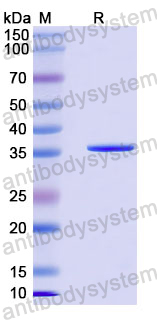
36.42 kDa
Nature
Recombinant
Applications
ELISA, Immunogen, SDS-PAGE, WB, Bioactivity testing in progress
Endotoxin level
Please contact with the lab for this information.
Purity
>90% as determined by SDS-PAGE.
Accession
Q8CFZ4
Form
Lyophilized
Storage buffer
Lyophilized from a solution in PBS pH 7.4, 0.02% NLS, 1mM EDTA, 4% Trehalose, 1% Mannitol.
Reconstitution
Reconstitute in sterile water for a stock solution. A copy of datasheet will be provided with the products, please refer to it for details.
Shipping
In general, proteins are provided as lyophilized powder/frozen liquid. They are shipped out with dry ice/blue ice unless customers require otherwise.
Stability and Storage
Use a manual defrost freezer and avoid repeated freeze thaw cycles. Store at 2 to 8°C for frequent use. Store at -20 to -80°C for twelve months from the date of receipt.
Alternative Names
Glypican-3, Glypican-3 alpha subunit, Glypican-3 beta subunit, Gpc3
Note
For research use only.
Expression of Concern: Glypican-3 promotes cell proliferation and tumorigenesis through up-regulation of b-catenin expression in lung squamous cell carcinoma., PMID:39139131
Biomarker discovery in hepatocellular carcinoma (HCC) for personalized treatment and enhanced prognosis., PMID:39191624
[68Ga]Ga-RAYZ-8009: A Glypican-3-Targeted Diagnostic Radiopharmaceutical for Hepatocellular Carcinoma Molecular Imaging-A First-in-Human Case Series., PMID:39266293
Protocol for preparing metabolically reprogrammed human CAR T cells and evaluating their in vitro effects., PMID:39306853
Integrated Imaging Probe and Bispecific Antibody Development Enables In Vivo Targeting of Glypican-3-Expressing Hepatocellular Carcinoma., PMID:39312187
The Inhibitory Effects of Anti-GPC3 Antibody on Wnt/β-Catenin Signaling Pathway as a Biological Therapy in Liver Cancer., PMID:39349719
Surrogate Immunohistochemical Markers of Proliferation and Embryonic Stem Cells in Distinguishing Ameloblastoma from Ameloblastic Carcinoma., PMID:39365497
The role of glypican-3 in hepatocellular carcinoma: Insights into diagnosis and therapeutic potential., PMID:39369212
Radiotherapy enhances the anti-tumor effect of CAR-NK cells for hepatocellular carcinoma., PMID:39396988
A sandwich-type electrochemical sensor based on RGO-CeO2-Au nanoparticles and double aptamers for ultrasensitive detection of glypican-3., PMID:39427046
Progress and challenges in glypican-3 targeting for hepatocellular carcinoma therapy., PMID:39428649
Undifferentiated embryonal sarcoma of the liver masquerading as a cystadenoma in a young adult: a case report., PMID:39487550
Evaluation of glypican‑3 in patients with hepatocellular carcinoma., PMID:39534882
Digital Quantitative Detection for Heterogeneous Protein and mRNA Expression Patterns in Circulating Tumor Cells., PMID:39556692
Interleukin-15-armoured GPC3 CAR T cells for patients with solid cancers., PMID:39604730
Label-free determination of glypican-3 using PtPd@H-rGO nanocomposites decorated light-addressable potentiometric sensor., PMID:39608318
Synthesis and Preclinical Evaluation of Dual-Specific Probe Targeting Glypican-3 and Prostate-Specific Membrane Antigen for Hepatocellular Carcinoma PET Imaging., PMID:39655726
Alpha-fetoprotein, glypican-3, and kininogen-1 as biomarkers for the diagnosis of hepatocellular carcinoma., PMID:39660335
GPC-3 in hepatocellular carcinoma; A novel biomarker and molecular target., PMID:39725192
Rapid evaluation of hepatocellular carcinoma by detecting plasma exosomes with time-resolved fluorescence immunochromatographic test strips., PMID:39731678
Chimeric antigen receptor-T cells targeting AFP-GPC3 mediate increased antitumor efficacy in hepatocellular carcinoma., PMID:39757079
MRI-Based Multifunctional Nanoliposomes for Enhanced HCC Therapy and Diagnosis., PMID:39809473
A proteomic atlas of glypican-3 interacting partners: Identification of alpha-fetoprotein and other extracellular proteins as potential immunotherapy targets in liver cancer., PMID:39822733
Multiplex immunohistochemistry to explore the tumor immune microenvironment in HCC patients with different GPC3 expression., PMID:39838375
Exploring Glypican-3 targeted CAR-NK treatment and potential therapy resistance in hepatocellular carcinoma., PMID:39841705
The molecular receptor NKBB enhances the persistence and anti-hepatocellular carcinoma activity of GPC3 CAR-T cells., PMID:39842473
Current Landscape of Adoptive Cell Therapy and Challenge to Develop "Off-The-Shelf" Therapy for Hepatocellular Carcinoma., PMID:39865534
Anti-GPC3 antibody and cell-penetrating peptide CPP44 dual-ligand modified liposomes for targeted delivery of arsenic trioxide in the treatment of hepatocellular carcinoma., PMID:39883090
Genomic landscape and potential therapeutic targets in alpha-fetoprotein-producing gastric cancer., PMID:39928247
Identification of 68 HLA-A24 and -A2-restricted cytotoxic T lymphocyte-inducing peptides derived from 10 common cancer-specific antigens frequently expressed in various solid cancers., PMID:39938154
Targeting glypican 3 by immunotoxins: the promise of immunotherapy in hepatocellular carcinoma., PMID:39985417
A novel self-autocatalytic DNAzyme and catalytic hairpin assembly molecular circuit for highly sensitive and non-label fluorescence aptamer glypican-3 assay., PMID:39998646
Induction of SOX17 with stimulation of WNT, TGF-beta, and FGF signaling drives embryonal carcinomas into the yolk-sac tumor lineage resulting in increased cisplatin resistance., PMID:40025812
Expression Profiles of Five Common Cancer Membrane Protein Antigens Collected for the Development of Cocktail CAR-T Cell Therapies Applicable to Most Solid Cancer Patients., PMID:40076777
CD4+ anti-TGF-β CAR T cells and CD8+ conventional CAR T cells exhibit synergistic antitumor effects., PMID:40107245
Glypican3 and serglycin as potential biomarkers involved in the pathogenesis of ovarian endometriosis., PMID:40139079
Exome analyses unravel the genetic architecture of Mendelian dominant nonsyndromic orofacial clefts., PMID:40147726
Current Advancements in Serum Protein Biomarkers for Hepatitis B Virus-Associated Hepatocyte Remodeling and Hepatocellular Carcinoma., PMID:40192058
Dual-antibody functionalized transistor biosensor for specific diagnosis of liver cancer., PMID:40203597
Diagnostic and prognostic performance of serum GPC3 and PIVKA-II in AFP-negative hepatocellular carcinoma and establishment of nomogram prediction models., PMID:40247208
Interplay of GPC3, Hsa-miR-135b-3p, and FTLP3 in lung cancer metastasis., PMID:40249471
A novel Wnt/β-catenin signaling gene signature for progression and metastasis of gastric cancer., PMID:40296906
Structural Features of Glypicans and their Impact on Wnt Signaling in Cancer., PMID:40416340
Unraveling Glypican-3: From Structural to Pathophysiological Roles and Mechanisms-An Integrative Perspective., PMID:40422229
Engineered E. coli OMVs Carrying the Membrane-Binding hGC33 Fragment Precisely Target Liver Cancer and Effectively Treat Tumor., PMID:40433120
Glypican-3 regulated epithelial mesenchymal transformation-related genes in osteosarcoma: based on comprehensive tumor microenvironment profiling., PMID:40433364
Nanomaterial-based biosensors for cancer diagnosis: trends and innovations (2022-2025)., PMID:40465004
GPC3-mediated lysosome-targeting chimeras (GLTACs) for targeted degradation of membrane proteins., PMID:40486834
Leveraging glypican-3 (GPC3)-mediated lysosome-targeting chimeras (GLTACs) for targeted membrane protein degradation., PMID:40486839
Bidirectional roles of nanoenzymes in enhancing GPC3-CAR T cell infiltration and cancer immunotherapy., PMID:40514690


 For research use only. Not for human or drug use.


