Catalog No.
YHK52101
Expression system
E. coli
Species
Homo sapiens (Human)
Protein length
Val262-Glu390
Predicted molecular weight
16.86 kDa
Nature
Recombinant
Applications
ELISA, Immunogen, SDS-PAGE, WB, Bioactivity testing in progress
Endotoxin level
Please contact with the lab for this information.
Purity
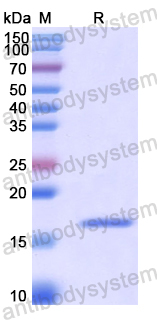
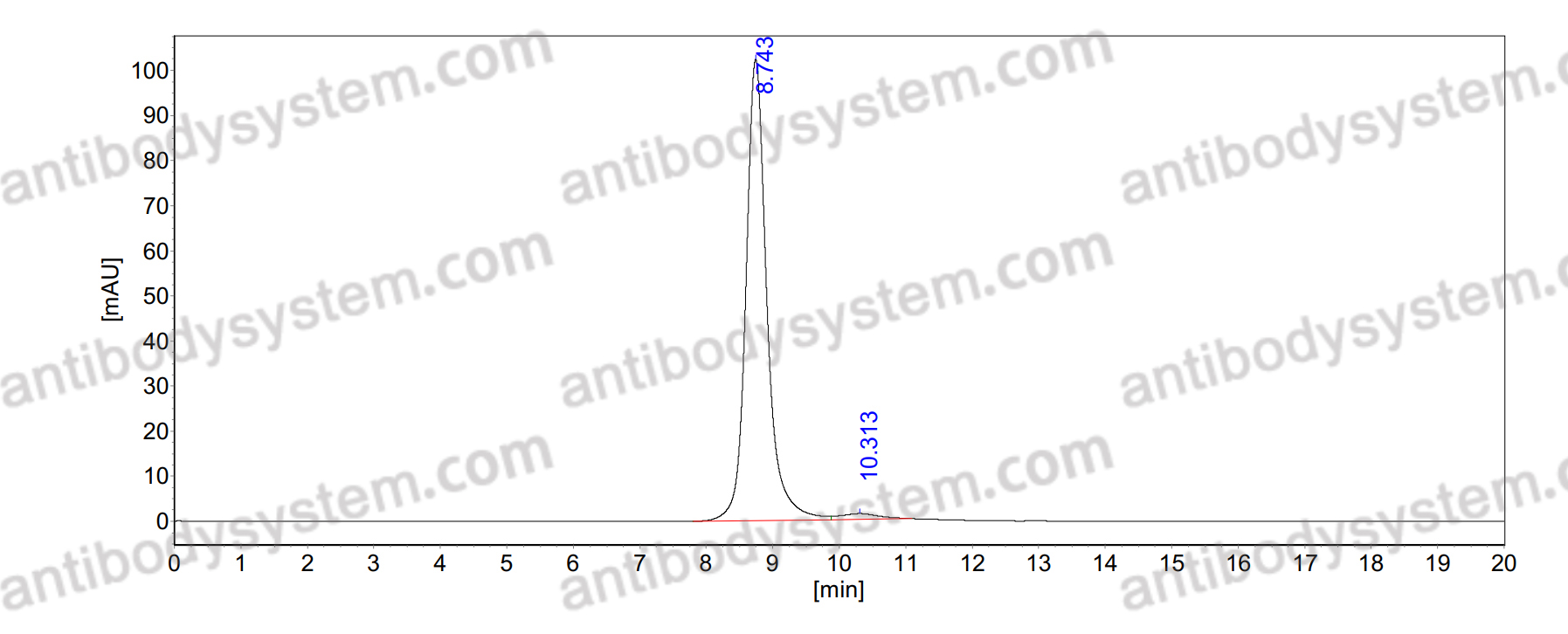
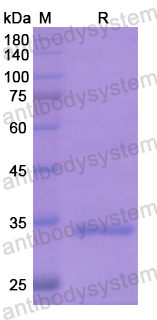
>90% as determined by SDS-PAGE.
Accession
Q6KB66
Form
Lyophilized
Storage buffer
Lyophilized from a solution in PBS pH 7.4, 0.02% NLS, 1mM EDTA, 4% Trehalose, 1% Mannitol.
Reconstitution
Reconstitute in sterile water for a stock solution. A copy of datasheet will be provided with the products, please refer to it for details.
Shipping
In general, proteins are provided as lyophilized powder/frozen liquid. They are shipped out with dry ice/blue ice unless customers require otherwise.
Stability and Storage
Use a manual defrost freezer and avoid repeated freeze thaw cycles. Store at 2 to 8°C for frequent use. Store at -20 to -80°C for twelve months from the date of receipt.
Alternative Names
Cytokeratin-80, Type-II keratin Kb20, KB20, Keratin, type II cytoskeletal 80, Keratin-80, CK-80, KRT80, K80
Note
For research use only.
Against the rules: human keratin K80: two functional alternative splice variants, K80 and K80.1, with special cellular localization in a wide range of epithelia., PMID:20843789
Differential gene regulation under altered gravity conditions in follicular thyroid cancer cells: relationship between the extracellular matrix and the cytoskeleton., PMID:21865726
Control of somatic tissue differentiation by the long non-coding RNA TINCR., PMID:23201690
A genome-wide association study identifies a locus on TERT for mean telomere length in Han Chinese., PMID:24465473
Long non-coding RNA expression profile in Cdk5-knockdown mouse skin., PMID:29890311
Keratin 80 promotes migration and invasion of colorectal carcinoma by interacting with PRKDC via activating the AKT pathway., PMID:30262880
SREBP1 drives Keratin-80-dependent cytoskeletal changes and invasive behavior in endocrine-resistant ERα breast cancer., PMID:31073170
Involvement of Dual Strands of miR-143 (miR-143-5p and miR-143-3p) and Their Target Oncogenes in the Molecular Pathogenesis of Lung Adenocarcinoma., PMID:31514295
Assessing protein sequencing in human single hair shafts of decreasing lengths., PMID:31590061
CircPIP5K1A activates KRT80 and PI3K/AKT pathway to promote gastric cancer development through sponging miR-671-5p., PMID:32169757
RNA sequencing-based microRNA expression signature in esophageal squamous cell carcinoma: oncogenic targets by antitumor miR-143-5p and miR-143-3p regulation., PMID:32623445
IL18-containing 5-gene signature distinguishes histologically identical dermatomyositis and lupus erythematosus skin lesions., PMID:32644977
A Genome-wide Association Study Identifies SERPINB10, CRLF3, STX7, LAMP3, IFNG-AS1, and KRT80 As Risk Loci Contributing to Cutaneous Leishmaniasis in Brazil., PMID:32830257
Small interfering RNA-mediated knockdown of KRT80 suppresses colorectal cancer proliferation., PMID:33101466
MK8722, an AMPK activator, inhibiting carcinoma proliferation, invasion and migration in human pancreatic cancer cells., PMID:34656065
Keratin 80 regulated by miR-206/ETS1 promotes tumor progression via the MEK/ERK pathway in ovarian cancer., PMID:34659572
WHO grading system for invasive pulmonary lung adenocarcinoma reveals distinct molecular signature: An analysis from the cancer genome atlas database., PMID:35339455
Transcriptomic Analysis of Annexin A10 and Chemosensitivity in Gastric Adenocarcinoma Cells., PMID:35346989
MiR-4268 suppresses gastric cancer genesis through inhibiting keratin 80., PMID:35748914
Molecular Pathogenesis of Colorectal Cancer: Impact of Oncogenic Targets Regulated by Tumor Suppressive miR-139-3p., PMID:36232922
Catechol-O-methyl transferase suppresses cell invasion and interplays with MET signaling in estrogen dependent breast cancer., PMID:36690660
KRT80 expression works as a biomarker and a target for differentiation in gastric cancer., PMID:37129345
Characters of KRT80 and its roles in neoplasms diseases., PMID:37211956
LINC01485 contributes to colorectal cancer progression by targeting miR-383-5p/KRT80 axis., PMID:37782686
Identification of autophagy and angiogenesis modulators in colorectal cancer based on bioinformatics analysis., PMID:37791824
PROTACs Targeting BRM (SMARCA2) Afford Selective In Vivo Degradation over BRG1 (SMARCA4) and Are Active in BRG1 Mutant Xenograft Tumor Models., PMID:38180485
The facilitating effects of KRT80 on chemoresistance, lipogenesis, and invasion of esophageal cancer., PMID:38241178
KRT80 Promotes Lung Adenocarcinoma Progression and Serves as a Substrate for VCP., PMID:38495507
Effect of dietary Eucommia ulmoides oliver polysaccharide on immune function and meat quality of Songliao Black Pigs., PMID:38886454
Loss of CELF2 promotes skin tumorigenesis and increases drug resistance., PMID:38887832
Identification of KRT80 as a Novel Prognostic and Predictive Biomarker of Human Lung Adenocarcinoma via Bioinformatics Approaches., PMID:38910478
The BET PROTAC inhibitor GNE-987 displays anti-tumor effects by targeting super-enhancers regulated gene in osteosarcoma., PMID:39090568
Brainstem transcriptomic changes in male Wistar rats after acute stress, comparing the use of duplex specific nuclease (DSN)., PMID:39300279
KRT80 in hepatocellular carcinoma plays oncogenic role via epithelial-mesenchymal transition and PI3K/AKT pathway., PMID:39569942
KRT80, Regulated by RNF8-Mediated Ubiquitination, Contributes to Glucose Metabolic Reprogramming and Progression of Glioblastoma., PMID:40146410
Increased keratin 80 expression predicts poor prognosis and promotes oxaliplatin resistance in gastric cancer., PMID:40182597
Characterization of Extrachromosomal Circular DNA in Primary and Cisplatin-Resistant High-Grade Serous Ovarian Cancer., PMID:40428339

 For research use only. Not for human or drug use.


