
South Sudan's Cholera Outbreak: What Makes Some Vibrio cholerae Strains Virulent?
As of August 5, 2026, South Sudan had reported 110,574 cholera cases and 1,721 deaths across 9 states, 55 counties, and 3 administrative areas. The outbreak is the largest reported in the country to date.

▲ South Sudan cholera (2026)
Beyond the scale of the outbreak lies a fundamental question in Vibrio cholerae research:
Why do some V. cholerae strains cause epidemic cholera, while others do not?
The answer goes well beyond the identification of V. cholerae. Serogroup, intestinal colonization, virulence genes, and mobile genetic elements all contribute to the pathogenic potential of individual strains.
Not All V. cholerae Strains Are Equally Virulent
Vibrio cholerae is widely distributed in aquatic environments, including freshwater, estuaries, and coastal waters. More than 200 O-antigen serogroups have been described, but O1 and O139 are the serogroups most closely associated with epidemic cholera.
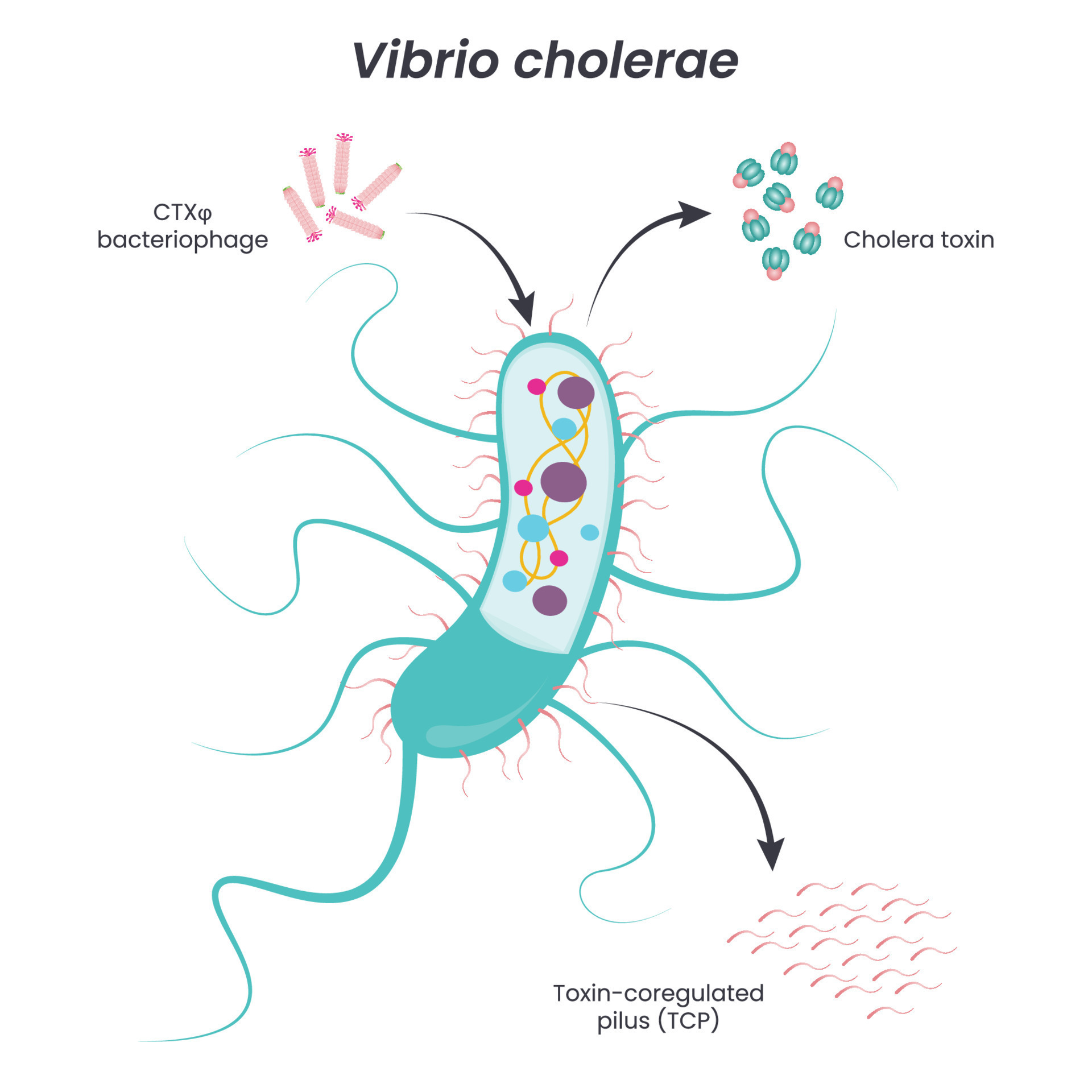
Non-O1/non-O139 strains should not simply be considered nonpathogenic. Some carry other virulence determinants and can cause diarrheal disease, bacteremia, and other extraintestinal infections. However, they generally lack the classical combination of virulence factors associated with epidemic cholera.
For researchers, identifying a strain as V. cholerae is therefore only the starting point. Key questions include: Which serogroup does the strain belong to? Can it colonize the intestinal tract? Does it carry major virulence determinants? And how do these genetic features shape its pathogenic phenotype?
These distinctions are essential for understanding the diversity of V. cholerae and its disease potential.
Step 1: Intestinal Colonization Requires More Than Survival
After ingestion through contaminated food or water, pathogenic V. cholerae must reach the small intestine and establish a stable niche.
A major factor in this process is the toxin-coregulated pilus (TCP), a type IV pilus that promotes intestinal colonization and microcolony formation. The genes encoding TCP are located within the Vibrio pathogenicity island (VPI).
TCP is particularly interesting because its role extends beyond bacterial adhesion. It also functions as a receptor for the CTXΦ bacteriophage, linking intestinal colonization to the acquisition of a major virulence determinant.
This connection illustrates an important feature of V. cholerae biology: the genetic systems that help the bacterium colonize the host are closely connected to the mechanisms through which it can acquire additional virulence traits.
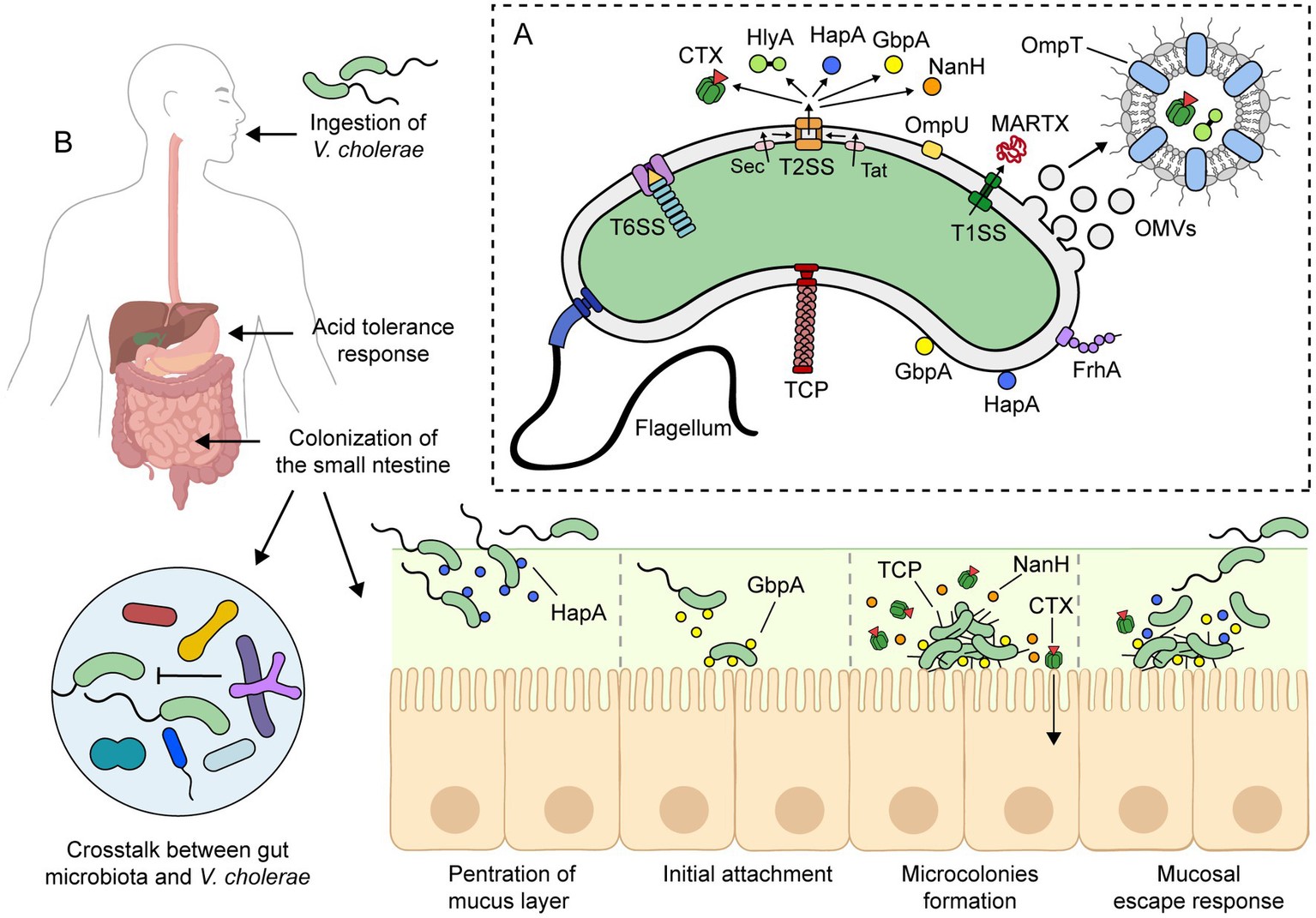
▲ Pathogenesis of toxigenic V. cholerae (PMCID: PMC10196187)
Step 2: CTXΦ and the Acquisition of Cholera Toxin Genes
The defining virulence factor of epidemic cholera is cholera toxin (CT). Its two subunits are encoded by ctxA and ctxB, which are carried by the CTXΦ-related genetic element.
CTXΦ is a filamentous bacteriophage that can infect V. cholerae and contribute to the acquisition and maintenance of cholera toxin genes.
This creates a key molecular framework for understanding toxigenic V. cholerae:
- VPI / TCP → intestinal colonization
- CTXΦ / ctxAB → cholera toxin production
These systems do not operate in isolation. Together, they contribute to the ability of epidemic V. cholerae strains to establish infection and produce the toxin responsible for the characteristic secretory diarrhea of cholera.
This is why the pathogenicity of V. cholerae cannot be reduced to a single virulence factor. It emerges from the interaction of colonization mechanisms, mobile genetic elements, and toxin expression.
Step 3: Why Is ctxB an Important Research Target?
Cholera toxin is an AB₅-type toxin consisting of one A subunit and a pentamer of B subunits.
The A subunit is responsible for the toxin's enzymatic activity, while the B subunit pentamer mediates binding to receptors on intestinal epithelial cells.
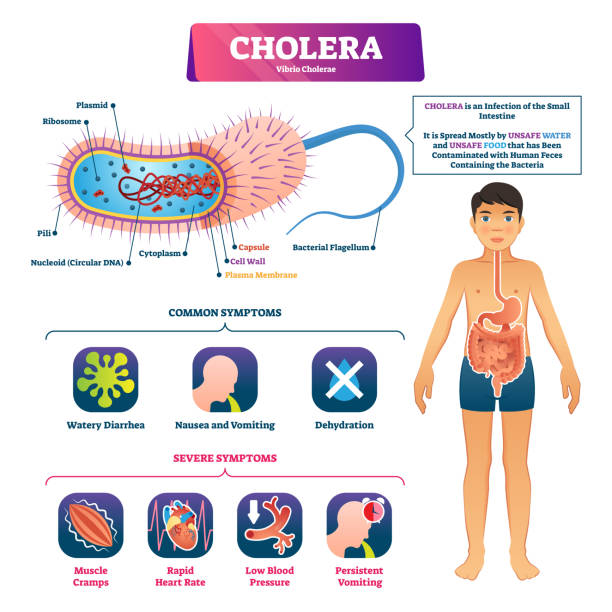
Following cellular uptake, the toxin disrupts intracellular signaling and elevates cAMP levels. This promotes the secretion of chloride and other electrolytes into the intestinal lumen, with water following osmotically. The result is the profuse watery diarrhea characteristic of cholera.
This makes ctxB more than a simple marker of V. cholerae. The encoded cholera toxin B subunit (CTB) plays a key role in toxin–host cell recognition and is therefore a relevant target for research into toxin structure, function, host interaction, and immunological detection.
For researchers, ctxB provides a useful entry point for investigating the relationship between toxin biology, bacterial virulence, and host–pathogen interactions.
Virulence Is Not Limited to O1 and O139
It is tempting to divide V. cholerae into two categories:
- O1/O139 = pathogenic
- non-O1/non-O139 = nonpathogenic
Biologically, this is too simplistic. Non-O1/non-O139 strains show substantial genetic diversity. Although many lack the classical CTX/TCP combination associated with epidemic cholera, some carry other virulence determinants, including hemolysins, RTX-associated toxins, and distinct secretion systems. These strains can cause a range of human infections.
The broader lesson is important:
Virulence is not a fixed property of the species. It is shaped by the combination of genetic determinants carried by each strain.
Serogroup provides one layer of classification. Colonization factors influence the ability to establish infection. Virulence genes determine specific pathogenic functions, while bacteriophages and other mobile genetic elements can introduce additional traits.
For this reason, studying V. cholerae requires looking beyond a single "cholera marker" and examining which virulence determinants a strain carries and how they interact to shape its pathogenic potential.
From Individual Targets to a Research Toolkit
This diversity also means that V. cholerae research extends well beyond cholera toxin.
LPS / Lipid A can support studies of bacterial surface structures and host recognition. ctxB / cholera toxin provides a route into toxin structure, function, and host interaction. higB-2 can be investigated in the context of virulence-related mechanisms, while targets such as DnaA and RctB provide additional entry points into DNA replication and strain-associated molecular biology.
AntibodySystem | V. cholerae Research Products
AntibodySystem provides research antibodies, nanobodies, and proteins targeting ctxB, higB-2, LPS/Lipid A, DnaA, RctB, and other V. cholerae-related targets for studies of virulence mechanisms, pathogen biology, and assay development.
From environmental V. cholerae to intestinal colonization, from CTXΦ acquisition to cholera toxin production, pathogenicity is shaped by a complex network of genetic and molecular determinants.
Understanding how individual strains acquire, maintain, and express these determinants is essential for studying the molecular basis of cholera and the broader pathogenic diversity of V. cholerae.
Recombinant Protein
| Catalog No. | Product Name |
|---|---|
| YXX05802 | Recombinant Vibrio cholerae serotype O1 ctxB/Cholera Toxin Subunit B Protein, N-His |
| YXX05801 | Recombinant Vibrio cholerae serotype O1 ctxB/Cholera Toxin Subunit B Protein, N-His-SUMO |
| YXX10501 | Recombinant Vibrio cholerae serotype O1 DnaA Protein, C-His |
| YXX10601 | Recombinant Vibrio cholerae serotype O1 RctB Protein, N-His |
Antibodies
| Catalog No. | Product Name |
|---|---|
| RXX02111 | Anti‑Vibrio cholerae LPS/Lipopolysaccharide Antibody (SAA0582) |
| RXX05801 | Anti‑Vibrio cholerae ctxB/Cholera Toxin Subunit B Nanobody (A9) |
| RXX05802 | Anti‑Vibrio cholerae ctxB/Cholera Toxin Subunit B Antibody (TE33) |
| RXX05805 | Anti‑Vibrio cholerae serotype O1 ctxB/Cholera Toxin Subunit B Nanobody (SAA1345) |
| RXX05803 | Anti‑Vibrio cholerae ctxB/Cholera Toxin Subunit B Antibody (SAA0848) |
| RXX05804 | Anti‑Vibrio cholerae ctxB/Cholera Toxin Subunit B Antibody (SAA0849) |
| PXX05801 | Anti‑Vibrio cholerae serotype O1 ctxB/Cholera Toxin Subunit B Polyclonal Antibody |
| PXX10501 | Anti‑Vibrio cholerae DnaA Polyclonal Antibody |
| PXX10601 | Anti‑Vibrio cholerae RctB Polyclonal Antibody |
| RXX10104 | Anti‑Vibrio cholerae serotype O1 higB‑2 Nanobody (SAA0877) |
| RXX10105 | Anti‑Vibrio cholerae serotype O1 higB‑2 Nanobody (SAA1029) |
| RXX10106 | Anti‑Vibrio cholerae serotype O1 higB‑2 Nanobody (SAA1035) |
| RXX10107 | Anti‑Vibrio cholerae serotype O1 higB‑2 Nanobody (SAA1174) |
| RXX10101 | Anti‑Vibrio cholerae higB‑2 Nanobody (SAA0850) |
| RXX10102 | Anti‑Vibrio cholerae higB‑2 Nanobody (SAA0851) |
| RXX10103 | Anti‑Vibrio cholerae higB‑2 Nanobody (SAA0852) |
References
- Front Med (Lausanne). 2023 May 5;10:1155751. doi: 10.3389/fmed.2023.1155751
- Living in the matrix: assembly and control of Vibrio cholerae biofilms
- Virulence Regulation and Innate Host Response in the Pathogenicity of Vibrio cholera


