
Is Your Antibody Purification Recovery Only 40%? Check the IgG Subclass First
"Why can someone else achieve over 90% recovery with Protein A, while my antibody gives me only 40%?"
If you work with antibody purification, this is probably not an unfamiliar situation.
When recovery is unexpectedly low, the first things people usually check are the purification conditions: Is the column still performing properly? Was too much sample loaded? Is the binding buffer appropriate? Should the elution conditions be adjusted?
These are all reasonable questions. But before replacing the column or repeatedly optimizing the purification conditions, there is another factor worth checking first:
What IgG subclass is your antibody?
Protein A is one of the most widely used affinity ligands for antibody purification, but it does not bind every IgG equally well.
Why can Protein A perform differently with different IgGs?
Protein A primarily interacts with the Fc region of IgG. It generally shows good binding to many commonly used human and rabbit IgGs, which is why Protein A has become such a standard choice for antibody purification.
The problem is that not all IgGs are structurally identical.
Fc regions vary between species and IgG subclasses, and these differences can affect how strongly an antibody interacts with Protein A or Protein G.
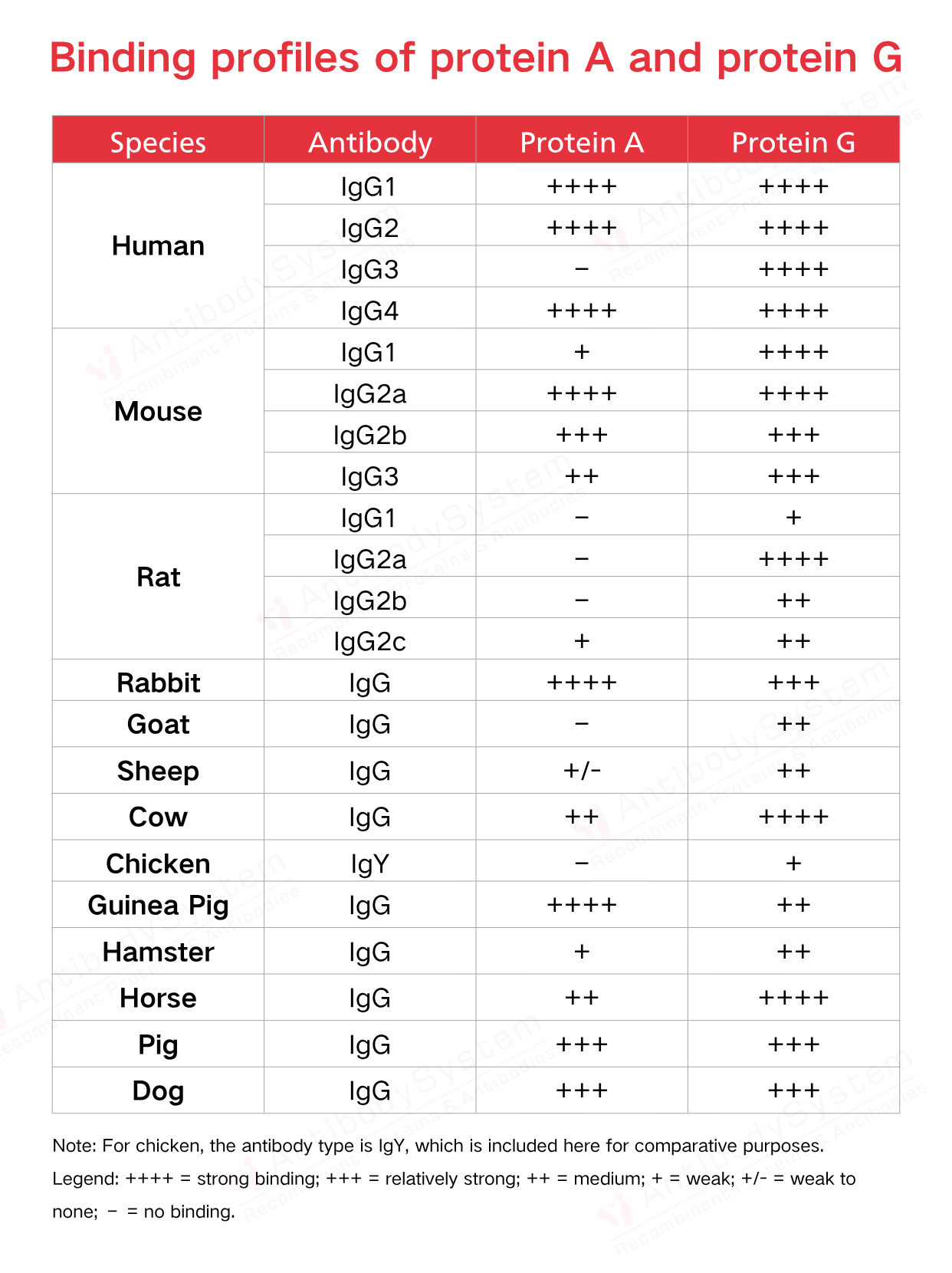
So, when purification recovery is unexpectedly low, it is worth looking beyond the column and buffer conditions and taking a closer look at the antibody itself.
One particularly useful place to start is the flow-through.
If a substantial amount of your target antibody is still present in the flow-through after loading, the problem may have occurred during the binding step.
At that point, instead of immediately assuming that the column is underperforming, ask:
Is this antibody actually a good match for Protein A?
Mouse IgG1 is a classic example
Mouse IgG1 is a good example of why antibody subclass matters.
In commonly used affinity purification systems, Mouse IgG1 generally shows weaker binding to Protein A, while Protein G often provides better binding performance.
As a result, when Mouse IgG1 is purified with Protein A, you may see a considerable amount of target antibody remaining in the flow-through, while the final elution yield is much lower than expected.
If this happens, it is tempting to keep changing the Protein A resin, adjusting the loading conditions, or optimizing the elution step.
But if the underlying issue is the interaction between the antibody and the affinity ligand, these changes may not address the root cause.
For Mouse IgG1, Protein G is generally worth evaluating first.
This does not mean that Mouse IgG1 can never be purified with Protein A. Actual binding performance can also be affected by the ligand source, resin matrix, buffer composition, pH, and the antibody itself.
A more accurate way to put it is:
Mouse IgG1 is generally not a strong Protein A-binding subclass, while Protein G often provides better binding.
So, if you are seeing a combination of Mouse IgG1 + Protein A + substantial antibody in the flow-through + low recovery, it may be more productive to compare Protein A and Protein G directly rather than continuing to optimize the same purification conditions.
Sometimes the problem is not the elution step at all. It starts with antibody capture.
Protein G is not simply a "better" version of Protein A
This can lead to another common misconception:
If Protein G works better for Mouse IgG1, should Protein G simply replace Protein A for antibody purification?
Not necessarily.
Protein A and Protein G are not simply "good" and "better" versions of the same ligand. Their binding preferences differ depending on the antibody.
For example, Rabbit IgG is a classic application for Protein A, and Protein A generally shows good binding to human IgG1, IgG2, and IgG4 as well.
For Mouse IgG1, on the other hand, Protein G is often a more suitable starting point.
A simplified guide is:
| Target antibody | Affinity ligand to consider |
|---|---|
| Rabbit IgG | Protein A is commonly used |
| Human IgG1 / IgG2 / IgG4 | Protein A is commonly used |
| Human IgG3 | Protein G may be worth evaluating |
| Mouse IgG1 | Protein G is often worth considering first |
| Other Mouse IgG subclasses | Evaluate based on the specific subclass |
| Rat IgG | Confirm the specific subclass before choosing |
This table should not be treated as an absolute rule. The actual performance of a purification system depends on the antibody and experimental conditions.
The more useful habit is simply this:
Don't assume "IgG = Protein A." Check the species and subclass before choosing the affinity ligand.
What if you don't know the IgG subclass?
For antibodies that have been expressed or produced in-house, the isotype can often be determined from the antibody construct, expression design, or other information associated with the antibody.
If the subclass is genuinely unknown, there is no need to immediately commit a large amount of sample to trial and error.
A small-scale comparison between Protein A and Protein G can be a practical way to evaluate the interaction.
And when comparing the two, don't look only at the final elution fraction. Check the flow-through as well.
If a significant amount of target antibody remains in the Protein A flow-through while Protein G substantially improves capture, that provides a strong indication that the affinity ligand may be an important factor.
For valuable or limited samples, a small-scale binding test before scaling up the purification can often save both sample and time.
So where should you start when recovery is only 40%?
When antibody purification recovery is unexpectedly low, start with the simplest questions.
First, check the flow-through.
If a large amount of target antibody is present, investigate the binding step first.
Next, check the antibody itself.
Confirm the species and IgG subclass rather than stopping at "it is an IgG."
Then, consider whether Protein A or Protein G is a better match.
If the antibody has limited affinity for the ligand being used, repeatedly adjusting other purification parameters may not solve the underlying problem.
Of course, if very little antibody is found in the flow-through but the final recovery is still low, the investigation should move toward other factors such as elution, sample stability, or downstream handling.
In other words:
Low recovery is a result, not a diagnosis.
Finding out where the antibody is actually being lost is the first step toward understanding what went wrong.
Don't look only at the target: Isotype matters too
This also highlights something worth remembering when selecting antibodies.
The first questions are usually about the target and application: Does the antibody recognize the protein of interest? Is it validated for WB, IHC, IF, IP, or another application?
Those questions are important. But when experiments involve antibody purification, immunoprecipitation, secondary antibody selection, or comparisons between antibodies, host species and isotype can also matter.
When evaluating an antibody, it is therefore useful to look beyond the target and application and check:
Host Species | Isotype | Clonality | Reactivity | Application
These may look like simple product specifications, but they can have practical consequences for experimental design and interpretation.
AntibodySystem provides a broad range of antibodies covering different host species, clonality, and applications, supporting diverse research needs.
| Catalog No. | Product Name |
|---|---|
| RHJ92831 | Anti-Human IgG Antibody (R1C56) |
| RHB96401 | Anti-Human IgG Antibody (R2X61) |
| VRJ92801 | InVivoMAb Rat IgG1 Isotype Control (HRPN) |
| VRB96801 | InVivoMAb Rat IgG2b Isotype Control (LTF-2) |
| VMB96401 | InVivoMAb Armenian hamster IgG Isotype Control (PIP) |
| RWJ93211 | Rhesus Monkey IgM Isotype Control Antibody (SPE-7) |
| RMK81501 | Mouse IgG Format Isotype Control for Bispecific Antibody (SAb2315) |
| RHJ92827 | Human IgG1 (P331S/E430G), kappa Isotype Control Antibody (HyHEL-10) |
| RHJ92826 | Human IgG1 (P329G/E356D/M358L), kappa Isotype Control Antibody (HyHEL-10) |
| FWK30512 | VHH Isotype Control Antibody (cAb-Lys2), PE |
| FRJ92710 | Rat IgE, kappa Isotype Control antibody (SPE-7) |
| FQD76410 | Canine IgA, kappa Isotype Control antibody (HyHEL-10) |
| FMJ92820 | Mouse IgG1, kappa Isotype Control Antibody (MOPC-21) |
| FMB96910 | Mouse IgG2C Isotype Control Antibody (HyHEL-10) |
| FMB96820 | Mouse IgG2b, kappa Isotype Control Antibody (MPC-11) |
| FMB96750 | Mouse IgG2a, kappa Isotype Control Antibody (MOPC-173) |
| FHK18010 | Human IgG1 fut Isotype Control Antibody (13R4) |


