
As temperatures rise and seasonal rainfall increases, mosquito activity intensifies across many regions of the world. Along with expanding mosquito populations comes renewed concern over mosquito-borne infectious diseases.
Recent risk assessments suggest that transmission risks associated with mosquito-borne viruses may continue to increase in 2026. Dengue virus (DENV), Chikungunya virus (CHIKV), and Zika virus (ZIKV) remain endemic in many tropical and subtropical regions while gradually expanding into new geographic areas. Climate change, urbanization, increasing international travel, and the spread of mosquito vectors have all contributed to growing public health and scientific interest in these pathogens.
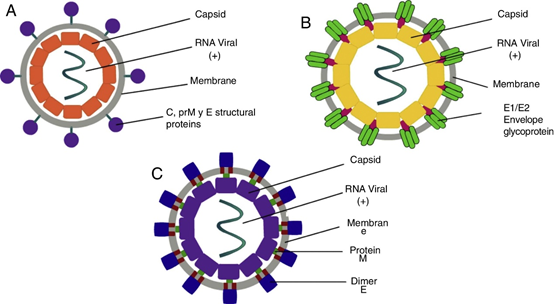
Structural of DENV (A), CHIKV (B), and ZIKV (C) (DOI: 10.1016/j.rmu.2017.09.001)
Although all three viruses are transmitted primarily by mosquitoes, they differ substantially in their virology, pathogenesis, and clinical outcomes. This article provides an overview of three of the most extensively studied mosquito-borne viruses: Dengue virus (DENV), Chikungunya virus (CHIKV), and Zika virus (ZIKV).
Dengue Virus (DENV)
Dengue is currently the most widespread mosquito-borne viral disease worldwide. Over the past decade, global dengue incidence has increased dramatically, with many countries reporting record numbers of infections.
DENV is primarily transmitted by Aedes aegypti and Aedes albopictus mosquitoes, which are widely distributed throughout tropical and subtropical regions.
Viral Structure
Dengue virus belongs to the genus Flavivirus within the family Flaviviridae. It is an enveloped, positive-sense single-stranded RNA virus approximately 50 nm in diameter. Its ~11 kb genome encodes three structural proteins and seven non-structural proteins.
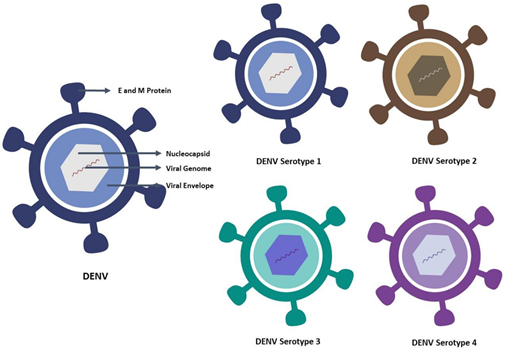
DENV and its four serotypes (PMID: 36423035)
Key Proteins
Envelope (E) Protein
Located on the viral surface, the E protein mediates host-cell attachment and viral entry. It is the principal target of neutralizing antibodies and a major focus of vaccine development efforts.
prM/M Protein
The precursor membrane protein (prM) and membrane protein (M) play essential roles in virion assembly and maturation, contributing to the formation of infectious viral particles.
NS1 Protein
NS1 is secreted during infection and serves as an important biomarker for early dengue diagnosis. It also plays critical roles in immune modulation and viral pathogenesis.
Why Is Dengue Important?
Dengue infection commonly presents with high fever, headache, retro-orbital pain, myalgia, arthralgia, and rash, earning it the nickname "breakbone fever." One of the most challenging aspects of dengue biology is the existence of four antigenically distinct serotypes (DENV-1 to DENV-4). Complex immune interactions among these serotypes continue to pose challenges for vaccine development and immunity studies.
Chikungunya Virus (CHIKV)
Chikungunya outbreaks have become increasingly common across Asia, Africa, and the Americas, often occurring alongside dengue epidemics in regions where the same mosquito vectors are present.
The name "Chikungunya" originates from the Makonde language and refers to the bent posture often observed in patients suffering from severe joint pain.
Viral Structure
CHIKV belongs to the genus Alphavirus within the family Togaviridae. Like DENV, it is an enveloped, positive-sense single-stranded RNA virus. Its genome encodes both structural and non-structural proteins, including two major envelope glycoproteins that are central to viral infection and immune recognition.
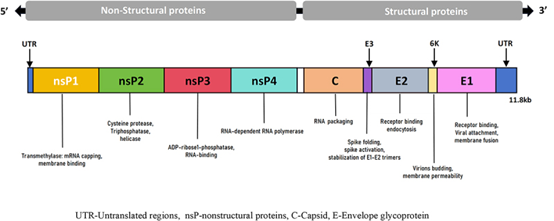
CHIKV genome organization (PMCID: PMC1140461)
Key Proteins
E1 Glycoprotein
E1 mediates membrane fusion between the virus and host cell, enabling viral entry.
E2 Glycoprotein
E2 is responsible for receptor recognition and attachment to host cells and represents a major target for neutralizing antibody responses.
Capsid (C) Protein
The capsid protein forms the viral nucleocapsid and protects the viral RNA genome.
Why Is Chikungunya Gaining Attention?
Clinical manifestations of chikungunya infection often resemble those of dengue, including fever, rash, and headache. However, severe joint pain is a hallmark feature of the disease. In some individuals, arthralgia can persist for months or even years after acute infection, making CHIKV an important model for studying virus-induced chronic inflammatory disease.
Zika Virus (ZIKV)
Zika virus was first identified in Uganda's Zika Forest in 1947. It attracted global attention during the large outbreaks of 2015--2016, when evidence emerged linking ZIKV infection to congenital neurological abnormalities.
Viral Structure
Like DENV, ZIKV belongs to the genus Flavivirus within the family Flaviviridae. The viral genome shares a similar organization and encodes both structural and non-structural proteins involved in viral replication and host interactions.
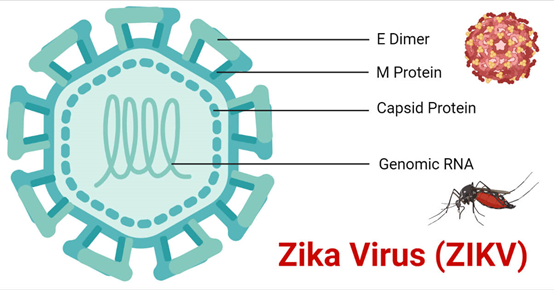
Structure of Zika virus (BioRender).
Key Proteins
Envelope (E) Protein
The E protein mediates viral attachment and entry into host cells and remains a primary target for vaccine and antibody development.
NS1 Protein
NS1 contributes to viral replication and immune modulation and is widely used as a diagnostic target.
NS5 Protein
NS5 functions as the viral RNA-dependent RNA polymerase and is indispensable for genome replication, making it an attractive target for antiviral drug discovery.
Why Is Zika Virus Significant?
In addition to causing fever, rash, and arthralgia, ZIKV is notable for its neurotropism. Studies have shown that the virus can infect neural progenitor cells and interfere with fetal neurological development. ZIKV infection has also been associated with neurological complications, including Guillain--Barré syndrome.
What Do These Three Viruses Have in Common?
Despite belonging to different viral families, DENV, CHIKV, and ZIKV share several important characteristics:
- Primarily transmitted by mosquito vectors, particularly Aedes species
- Enveloped positive-sense single-stranded RNA viruses
- Significant geographic overlap in endemic regions
- Similar early clinical presentations that can complicate diagnosis
- Ongoing demand for vaccines, therapeutic antibodies, and diagnostic assays
These shared features make them common targets for comparative studies and integrated mosquito-borne disease research programs.
Why Is Mosquito-Borne Virus Research Expanding?
Research efforts continue to accelerate across multiple areas of mosquito-borne virus biology, from fundamental studies of viral entry mechanisms to the development of vaccines, therapeutic antibodies, diagnostic assays, and antiviral agents.
Current research priorities include:
- Viral structure and function
- Host receptor interactions
- Neutralizing antibody discovery
- Vaccine evaluation and immunogenicity studies
- Antigen detection assay development
- Viral replication mechanisms
- Host immune responses
As mosquito-borne disease risks continue to evolve globally, these research areas remain critical for advancing prevention, diagnosis, and therapeutic strategies.
Mosquito-Borne Virus Research Tools from AntibodySystem
AntibodySystem offers a comprehensive portfolio of research reagents supporting studies of Dengue virus (DENV), Chikungunya virus (CHIKV), Zika virus (ZIKV), including:
✓ Recombinant proteins (E, NS1, NS5, E1, E2, and more)
✓ Monoclonal antibodies
✓ Matched antibody pairs
✓ ELISA kits
✓ Additional reagents for virology research
Our products support a wide range of applications, including viral pathogenesis studies, vaccine development, antibody discovery, diagnostic assay development, and antiviral research.
For additional product information or technical documentation, please contact the AntibodySystem team.
DENV Related Products
| Catalog | Product Name |
|---|---|
| YVV15801 | Recombinant DENV-2 NS1/Non-structural protein 1 Protein, N-His |
| YVV19905 | Recombinant DENV-1 Envelope protein E, N-His |
| YVV19904 | Recombinant DENV-4 Envelope protein E, N-His |
| YVV19902 | Recombinant DENV-3 Envelope protein E, N-His |
| YVV31501 | Recombinant DENV-1 Capsid protein C/Core protein Protein, N-GST & C-His |
| YVV31601 | Recombinant DENV-2 NS3/Serine protease NS3 Protein, N-His |
| YVV25301 | Recombinant DENV-1 Protein prM/prM Protein, N-GST & C-His |
| RVV04001 | Anti-DENV-2 E-DII/Envelope Protein E Antibody (2A10) |
| RVV04201 | Anti-Dengue Virus NS1 antibody |
| VVV25303 | InVivoMAb Anti-DENV2 Protein prM/prM Antibody (2H2) |
| RVV04002 | Anti-DENV-2 E-DII/Envelope Protein E Antibody (2A10) |
| VVV19902 | InVivoMAb Anti-DENV-2 Envelope protein E/EDIII (Iv0125) |
| VVV19901 | InVivoMAb Anti-DENV-2 Envelope protein E/EDIII (Iv0124) |
| RVV11701 | Anti-Dengue and Zika virus EDE1 Antibody (EDE1C10) |
| RVV04101 | Anti-DENV-2 E-DIII antibody (1A1D) |
CHIKV Related Products
| Catalog | Product Name |
|---|---|
| EVV09601 | Recombinant CHIKV Spike glycoprotein E1 Protein, C-Fc |
| YVV40501 | Recombinant CHIKV NSP2 Protein, N-GST-His |
| EVV09702 | Recombinant CHIKV Spike glycoprotein E2 Protein, C-His |
| EVV09701 | Recombinant CHIKV Spike glycoprotein E2 Protein, C-Fc |
| RVV09602 | Anti-CHIKV p130/Structural polyprotein Antibody (CHK152) |
| RVV09704 | Anti-CHIKV Spike glycoprotein E2 Antibody (5F10) |
| RVV09601 | Anti-CHIKV p130/Structural polyprotein Antibody (9.8B) |
| RVV09703 | Anti-CHIKV Spike glycoprotein E2 Antibody (4J21) |
ZIKV Related Products
| Catalog | Product Name |
|---|---|
| YVV31402 | Recombinant ZIKV Envelope protein E Protein, N-His |
| EVV26601 | Recombinant Zika virus (ZIKV) NS1 Protein, C-His |
| YVV26601 | Recombinant ZIKV NS1 Protein, C-His |
| YVV31701 | Recombinant ZIKV Capsid protein C/Core protein Protein, N-GST & C-His |
| YVV31801 | Recombinant ZIKV Protein prM/prM Protein, N-GST & C-His |
| EVV31401 | Recombinant ZIKV Envelope protein E Protein, C-His |
| YVV31901 | Recombinant ZIKV NS3/Serine protease NS3 Protein, N-His |
| RVV04002 | Anti-DENV-2 E-DII/Envelope Protein E Antibody (2A10) |
| RVV11701 | Anti-Dengue and Zika virus EDE1 Antibody (EDE1C10) |
| RVV19921 | Anti-DENV-2 Envelope protein E/EDE1 Antibody (C10) |
| RVV26601 | Anti-Zika virus/ZIKV NS1c Antibody (DV62.5) |
| RVV31401 | Anti-ZIKV Envelope protein E/DIII domain Antibody (Z004) |
| VVV26601 | InVivoMAb Anti-ZIKV/DENV NS1c Antibody (1G5) |
| VVV31401 | InVivoMAb Anti-ZIKV Envelope protein E Antibody (Z23) |


