
Anyone who has worked with multicolor flow cytometry has probably experienced this at some point. One population looks slightly off, so you make a small compensation adjustment. Then another channel starts to distort. You adjust again, and now the negative population shifts. A few more tweaks later, the entire dataset looks far worse than it did in the beginning.
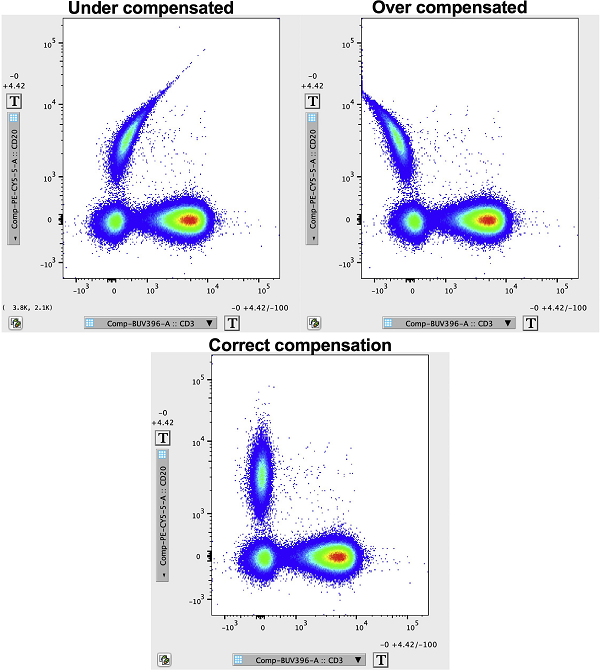
Comparison of under compensation, over compensation, and correct compensationComparison of under compensation, over compensation, and correct compensation
At that stage, many people start to wonder whether compensation is inherently subjective — whether there is ever a truly "correct" setting. In reality, the problem is usually not the adjustment itself, but a misunderstanding of what compensation is actually designed to do.
Many beginners approach compensation as though it were a way to improve plot appearance. If the double-positive population seems too large, they reduce it slightly. If a population appears tilted, they try to straighten it. If the negatives do not cluster neatly, they continue adjusting until the plots look cleaner. Compensation gradually turns into a form of visual optimization rather than signal correction.
But compensation is not intended to make plots look aesthetically pleasing. Its purpose is to correct for fluorescence spillover.
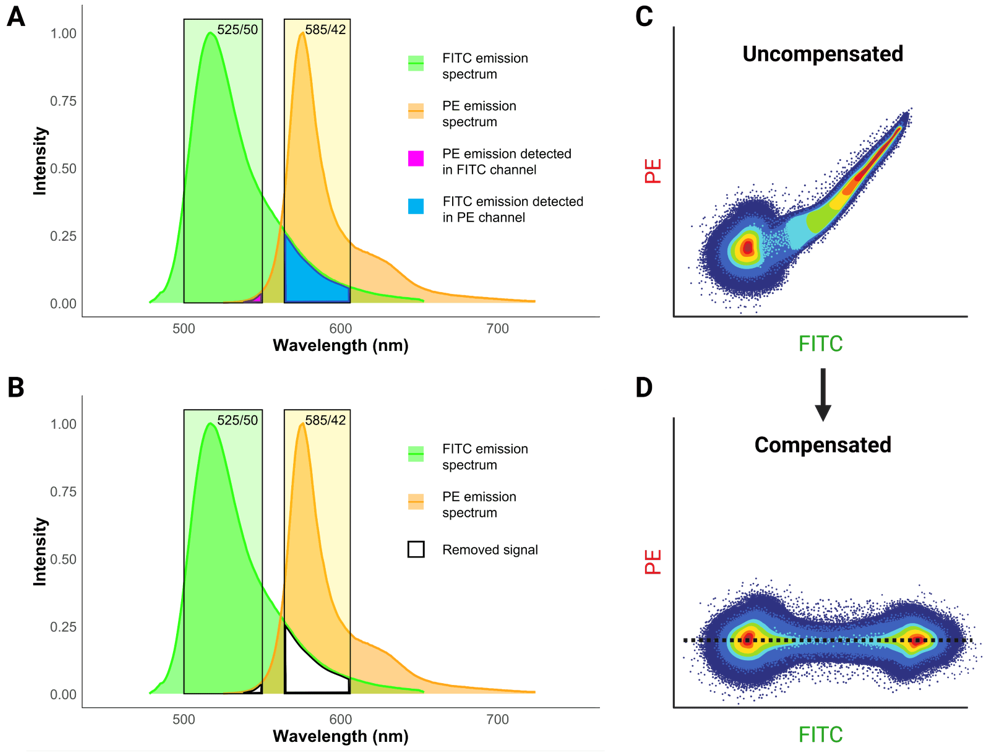
Schematic illustration of fluorescence spillover and the compensation principle between FITC and PE
Fluorochromes do not emit perfectly isolated signals. Their emission spectra overlap naturally. A portion of the FITC signal, for example, can be detected in the PE channel, while PE may also spill into neighboring detectors. What the cytometer records is therefore a composite signal rather than a completely pure measurement from a single fluorophore. Compensation mathematically subtracts the fraction of signal that originates from spectral overlap.
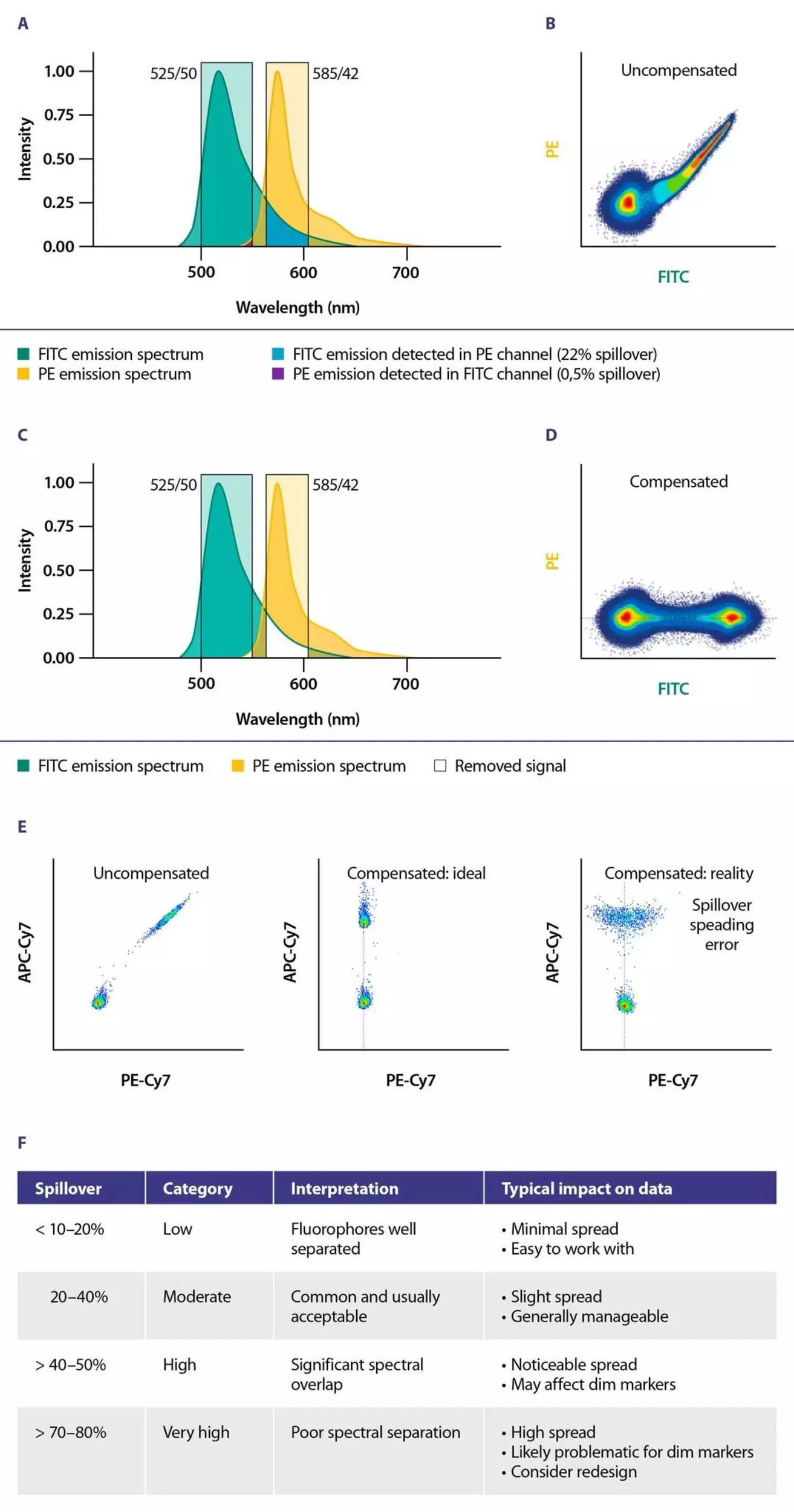
Flow Cytometry Spectral Overlap Guide
The issue is that compensation is often built on poor-quality input data from the very beginning.
One of the most common problems is improperly prepared single-stained controls. Many users rely directly on experimental samples, even when marker expression is weak, positive and negative populations are poorly separated, or the cell population itself is unstable. Under those conditions, the calculated compensation matrix becomes unreliable. Low-expression markers are especially problematic because dim positive signals make it difficult for the instrument to accurately determine spillover coefficients. The result is predictable: the more compensation is adjusted, the more unstable the data appears.
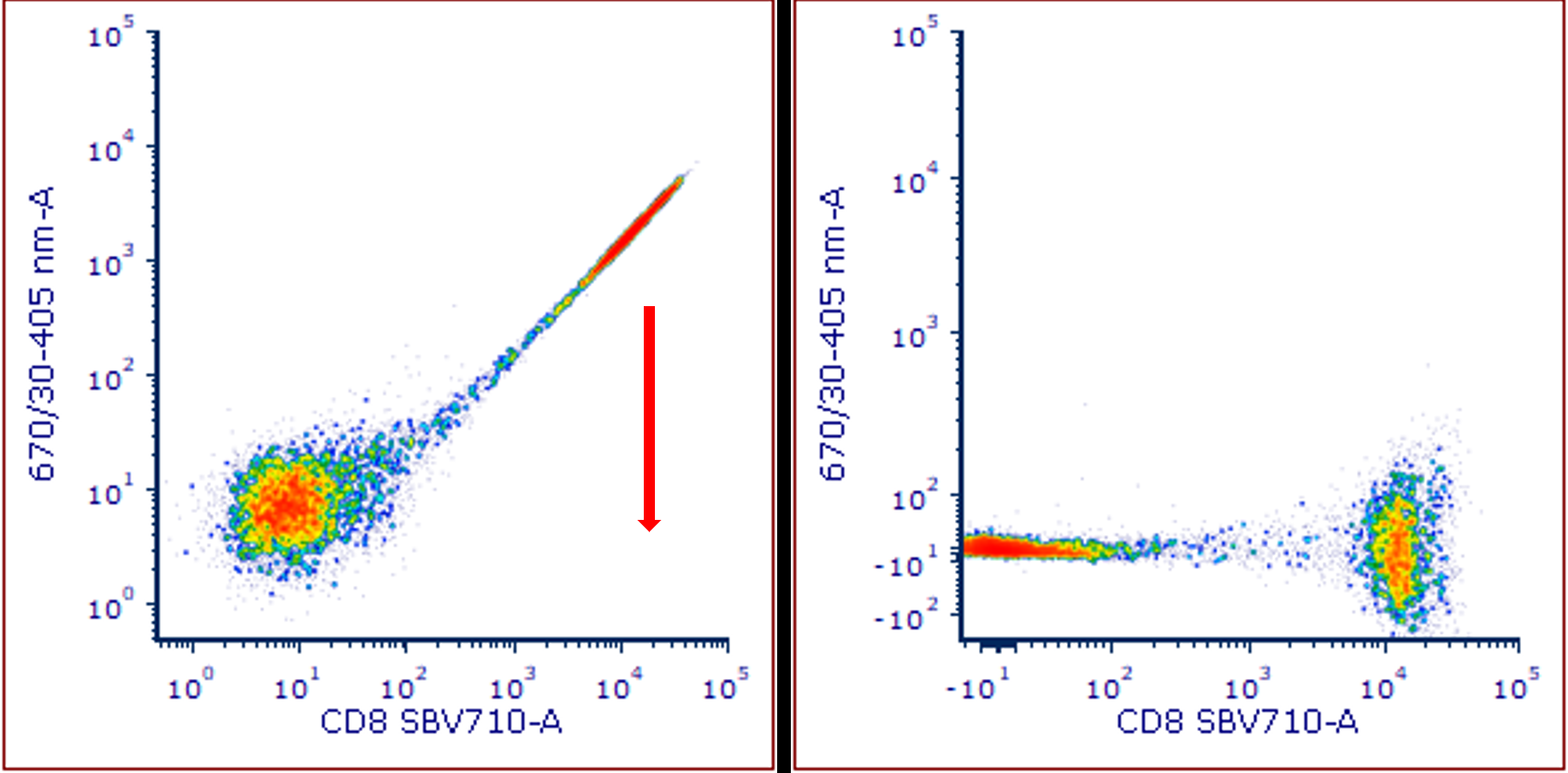
Single Staining Controls in Flow Cytometry
Another major source of trouble is excessive cell death within the sample.
Dead cells do far more than simply make a sample look "messy." They often exhibit increased autofluorescence and substantial nonspecific antibody binding, which can blur negative populations and distort baseline signal distributions. When users see negative populations shifting or broadening, they frequently assume compensation is incorrect and begin aggressively modifying the matrix. In many cases, however, the real problem is poor sample quality rather than faulty compensation.
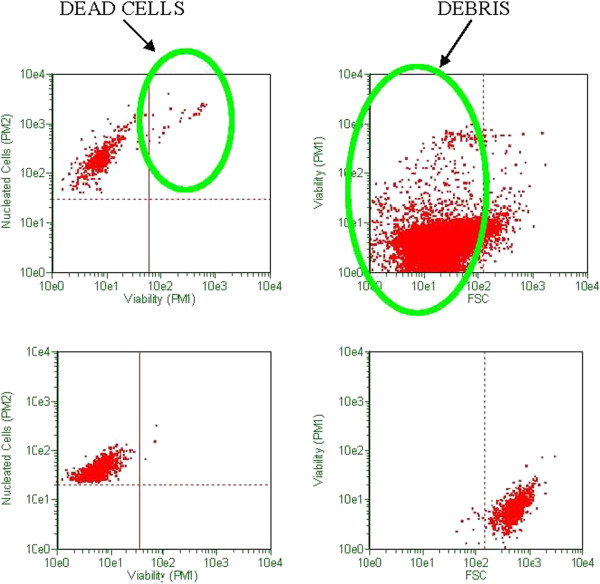
Viability and debris analysis by flow cytometry using ViaCount stain. ( PMCID: PMC3477126)
Another common mistake is adjusting compensation and gating simultaneously. Compensation changes naturally alter population positioning. If gates are continuously redefined at the same time, it becomes very easy to convince yourself that the data is improving, even while the overall analysis is drifting further away from objective interpretation.
Fluorochrome brightness is another factor that is often underestimated. Not every marker is compatible with every fluorophore. Pairing a highly expressed antigen with an extremely bright dye such as PE can create overwhelming signal intensity, while assigning a dim fluorochrome to a low-expression marker may leave the population barely distinguishable from background noise. When that happens, compensation is often blamed even though the underlying issue originated during panel design.
An additional point that many people overlook is that compensation does not truly eliminate spillover. It only corrects the average contribution of overlapping signals. Even with technically correct compensation, highly fluorescent markers can still introduce substantial spreading error into neighboring channels. As a result, populations may remain broad or double-positive events may still appear inflated despite proper compensation settings.
For that reason, compensation that seems to "make things worse" is often exposing problems that compensation itself cannot solve.
The underlying issue may be poor single-color controls, excessive dead cells, suboptimal panel design, or marker expression levels that are simply too low for reliable separation. Experienced flow cytometrists rarely respond to problematic data by immediately manipulating the compensation matrix. Instead, they first determine whether the issue truly originates from compensation or from the experiment itself.
Because in flow cytometry, the greatest risk is not generating imperfect-looking plots.
It is creating data that appears biologically convincing while being fundamentally misleading.


