
On May 9, the U.S. Centers for Disease Control and Prevention (CDC) reported a norovirus outbreak aboard the Caribbean Princess, operated by Princess Cruises. The ship departed from Fort Lauderdale, Florida on April 28, and during the voyage, 102 passengers and 13 crew members developed symptoms consistent with norovirus infection. Public health authorities have since implemented enhanced control measures, including intensified sanitation procedures, passenger isolation, and laboratory testing of clinical samples.

Caribbean Princess cruise ship
According to CDC data, the outbreak affected approximately 3.3% of the 3,116 passengers onboard and 1.2% of the 1,131 crew members. While these numbers may appear relatively limited, norovirus outbreaks in cruise ship settings remain a significant public health concern due to the highly transmissible nature of the virus in densely populated and enclosed environments.
Cruise ships have long been recognized as one of the most common settings for norovirus outbreaks. Shared dining facilities, elevators, entertainment areas, and restrooms, combined with prolonged close contact among passengers, create ideal conditions for rapid viral transmission through contaminated surfaces, food, water, and person-to-person contact.
The incident has once again brought renewed attention to norovirus, one of the world's leading causes of acute gastroenteritis.
Norovirus: A Major Cause of Acute Gastroenteritis Worldwide
Norovirus is among the most common viral pathogens responsible for acute gastroenteritis globally. It is estimated to cause approximately 677 million cases of acute gastroenteritis each year worldwide.
Typical symptoms include vomiting, diarrhea, nausea, abdominal pain, and low-grade fever. Although the disease is generally self-limiting and resolves within several days, severe outcomes may occur in young children, older adults, and immunocompromised individuals.
What makes norovirus particularly challenging is not its mortality rate, but its extraordinary transmissibility. Studies have shown that infection can occur with an extremely low infectious dose. In addition, as a non-enveloped virus, norovirus exhibits substantial environmental stability and can remain infectious on contaminated surfaces for extended periods while tolerating certain routine disinfection conditions.
As a result, schools, daycare centers, hospitals, nursing homes, and cruise ships frequently become hotspots for norovirus-associated outbreaks.
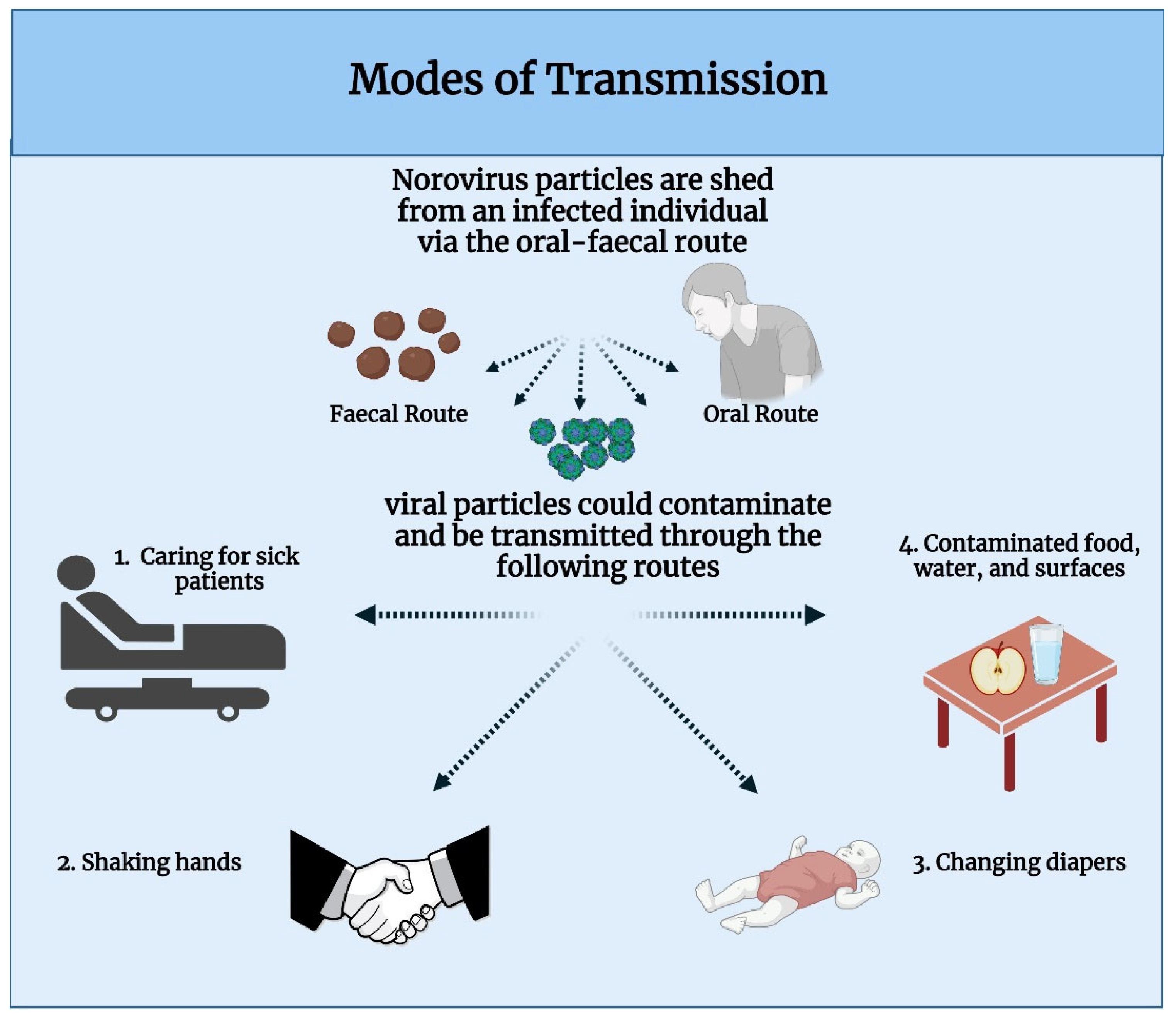
Transmission Modes of NoV reported by the CDC (DOI: 10.3389/fimmu.2020.0096)
Understanding Norovirus Biology
Norovirus belongs to the genus Norovirus within the family Caliciviridae. It is a non-enveloped, positive-sense single-stranded RNA virus with a genome approximately 7.5 kb in length and a particle diameter of roughly 27--40 nm.
The viral genome encodes multiple non-structural proteins, including p48 (NS1/2), p41 (NS3), p22 (NS4), VPg (NS5), the viral protease (NS6), and the RNA-dependent RNA polymerase RdRp (NS7). These proteins play critical roles in viral RNA replication, replication complex formation, polyprotein processing, and modulation of host cellular pathways.
Among them, RdRp serves as the core enzyme driving viral genome replication and remains a key target in antiviral research.
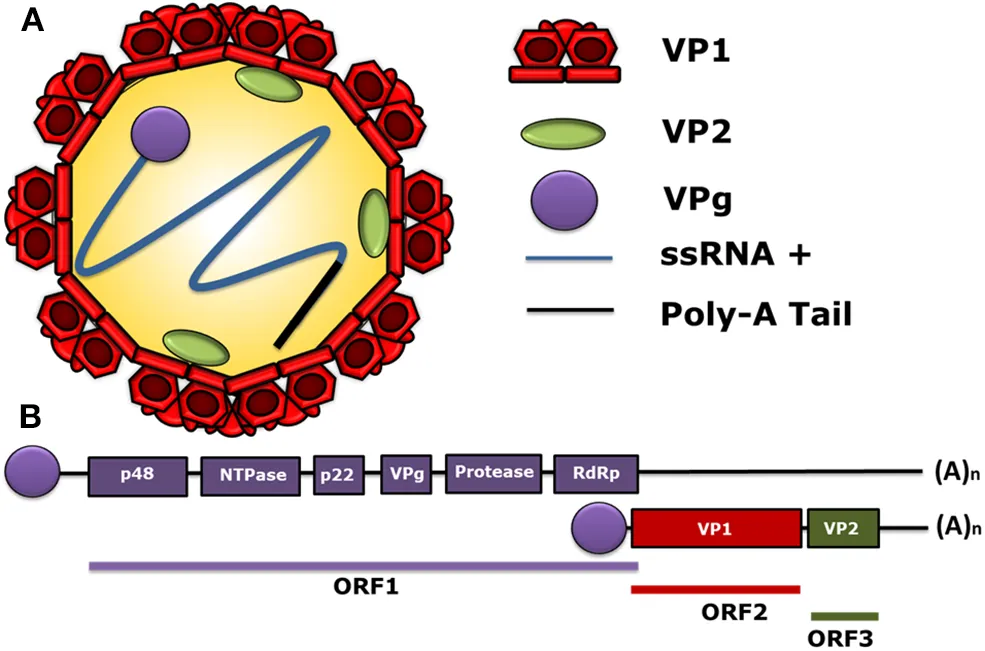
Molecular structure of human norovirus (PMID: 32612600)
In addition to the non-structural proteins, norovirus contains two major structural proteins: VP1 and VP2. VP1, the major capsid protein, is by far the most extensively studied and biologically important viral structural component. Notably, VP1 can self-assemble into virus-like particles (VLPs), making it highly valuable for vaccine development, neutralizing antibody discovery, and diagnostic assay development. VP2, located internally within the capsid, contributes to genome packaging and virion stabilization.
Table of the known functions of the structural and non-structural proteins of HuNoV (PMID: 32612600)
| Proteins | Function |
|---|---|
| NS ½ | ° Modulate the activity of the viral polymerase (RdRp). ° Alter multiple immune systems. ° Function as an agonist of cellular secretory pathways. |
| NS 3 | ° Similar activity to helicase ° Union and hydrolysis of nucleoside triphosphates. ° It helps in the synthesis of RNA in vitro carried out by the RdRp. |
| NS 4 | ° Mimics an export signal for vesicles coated with COPII from the RER. ° Prevents the union of vesicles with the Golgi Apparatus. ° Ability to induce disassembly of the Golgi Apparatus. ° Antagonistic activity of the secretion of proteins that depend on the Golgi Apparatus. |
| NS 5 | ° Interact with initiation factors such as eIF3. ° Direct the synthesis of viral proteins. |
| NS 6 | ° Responsible for processing the viral polyprotein. |
| NS7 | ° Translation of viral RNA. |
| VP 1 | ° Structural protein. ° Binding of the virus to HBGA. ° Immune escape. |
| VP 2 | ° Translation of viral RNA. ° Structural protein. ° Stability of the viral capsid. |
Based on genetic diversity, noroviruses are classified into multiple genogroups and genotypes. Human infections are primarily associated with genogroups GI, GII, GIV, GVIII, and GIX. Among these, GII.4 has remained the predominant epidemic genotype worldwide for more than two decades and continues to represent a primary focus of vaccine research efforts.
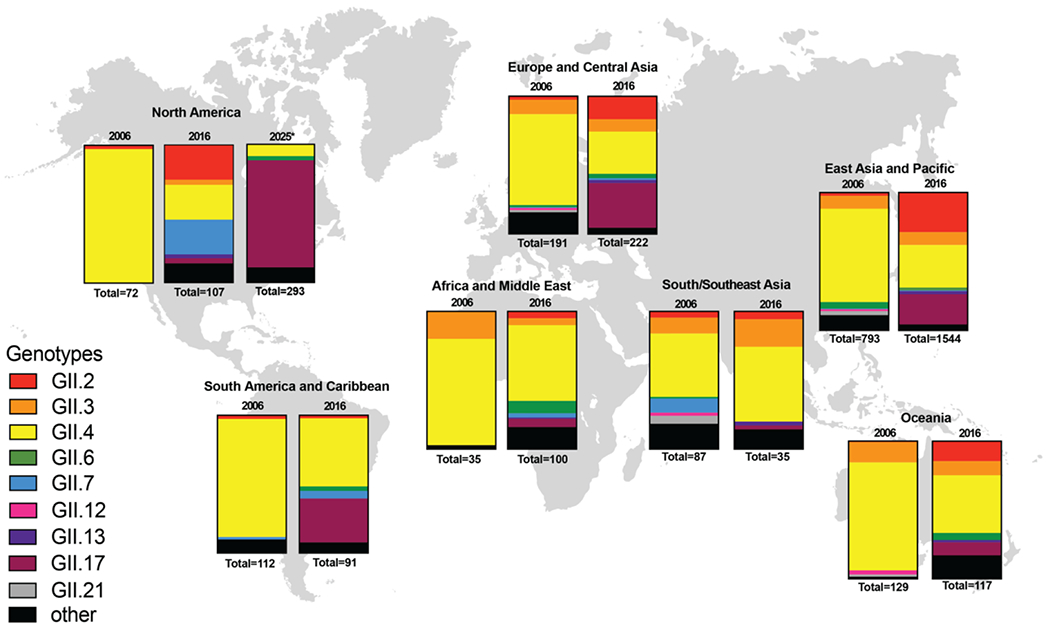
Circulating Norovirus strains diversify rapidly across time and space (PMCID: PMC13020347)
Why Has Norovirus Vaccine Development Been So Difficult?
Despite the substantial global disease burden associated with norovirus infection, there are currently no approved vaccines or specific antiviral therapies available.
One of the major challenges lies in the long-standing lack of robust and reproducible in vitro culture systems for human norovirus. Unlike influenza viruses or SARS-CoV-2, norovirus has historically been difficult to propagate efficiently in conventional cell culture models, significantly limiting virology research, antiviral screening, and traditional vaccine development approaches.
Consequently, current vaccine development strategies have shifted heavily toward recombinant protein and virus-like particle (VLP)-based platforms.
Because VP1 can spontaneously assemble into VLPs that closely mimic the native viral capsid structure without being infectious, VP1-based VLPs have emerged as the leading antigen design strategy for norovirus vaccine candidates. Several VP1-based vaccine candidates have already advanced into clinical development using insect cell, mammalian cell, and plant-based expression systems.
More recently, advances in human intestinal organoid culture technologies and increasing insight into norovirus-host interactions have begun to provide new opportunities for studying viral replication and accelerating vaccine development.
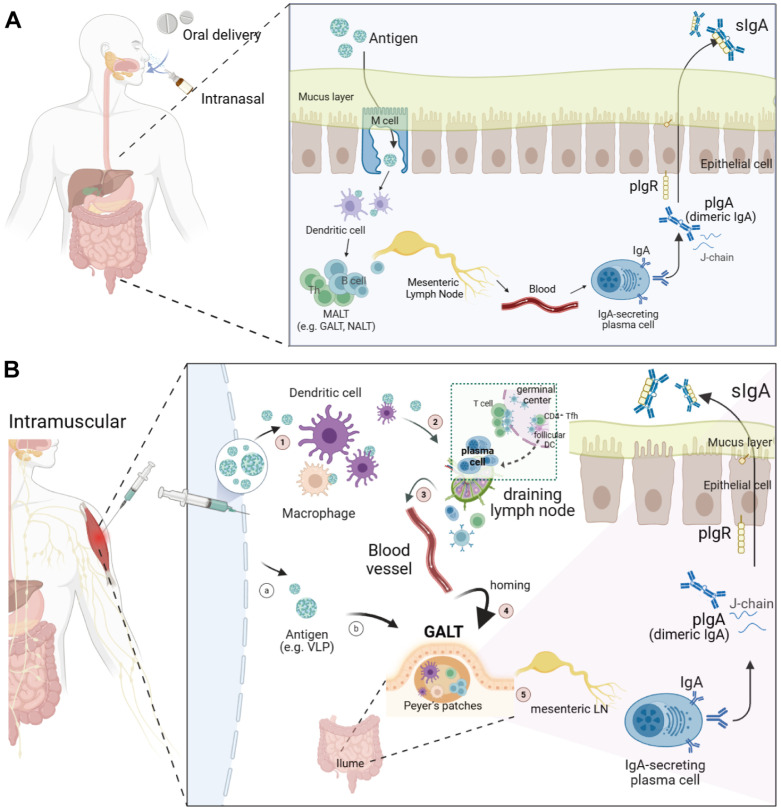
Pathways and mechanisms of mucosal sIgA induction by HuNoV vaccine administered via oral, intranasal, or intramuscular routes (PMID: 41218799)
VP1 Remains a Central Target in Norovirus Research
Due to the difficulty of viral culture, rapid transmission dynamics, and continuous viral evolution, norovirus research relies heavily on high-quality recombinant proteins and highly specific antibody tools.
VP1-related proteins and antibodies are now widely used in multiple research applications, including vaccine immunogen development, epitope mapping, neutralizing antibody screening, ELISA assay development, structural biology studies, and diagnostic assay development.
To support these research efforts, AntibodySystem provides a range of norovirus-related recombinant proteins and antibodies for applications spanning basic research, vaccine development, and diagnostic assay development.
Selected products include:
| Catalog No. | Product Name |
|---|---|
| EVV25601 | Recombinant Norovirus GII VP1/ORF2 Protein, C-His |
| RVV25604 | Anti-Norovirus/Norwalk Virus Capsid Protein/VP1 Nanobody (Nano-85) |
| RVV25605 | Anti-Norovirus/Norwalk Virus Capsid Protein VP1/p59 Antibody (5I2) |
| RVV25606 | Anti-Norovirus/Norwalk Virus Capsid Protein VP1/p59 Antibody (Nano-7) |
| RVV25607 | Anti-Norovirus/Norwalk Virus Major Capsid Protein/VP1 Antibody (A1431) |
| RVV33401 | Anti-Mouse Norovirus Capsid Protein Antibody (A6.2) |
| RVV25601 | Anti-Norovirus/Norwalk Virus Capsid Protein Antibody (5B18) |
| RVV25602 | Anti-Norovirus/Norwalk Virus Capsid Protein/VP1 Antibody (Nano-4) |
| RVV25603 | Anti-Norovirus/Norwalk Virus Capsid Protein/VP1 Antibody (Nano-25) |
| RVV25608 | Anti-Norovirus/Norwalk Virus Major Capsid Protein/VP1 Antibody (A1227) |
Conclusion
The recent outbreak aboard the Caribbean Princess serves as another reminder that norovirus remains one of the most challenging viral pathogens in public health settings, particularly in crowded and enclosed environments.
Its exceptionally low infectious dose, environmental persistence, and rapid transmission dynamics continue to complicate outbreak control efforts worldwide. At the same time, the absence of robust culture systems and approved vaccines has posed significant scientific and technical barriers to therapeutic and vaccine development.
Nevertheless, continued advances in organoid-based infection models, VLP technologies, recombinant protein platforms, and structural virology are rapidly accelerating progress in the field. Future studies focused on VP1, RdRp, and virus-host interaction mechanisms are expected to remain central to the development of next-generation norovirus vaccines and diagnostics.


