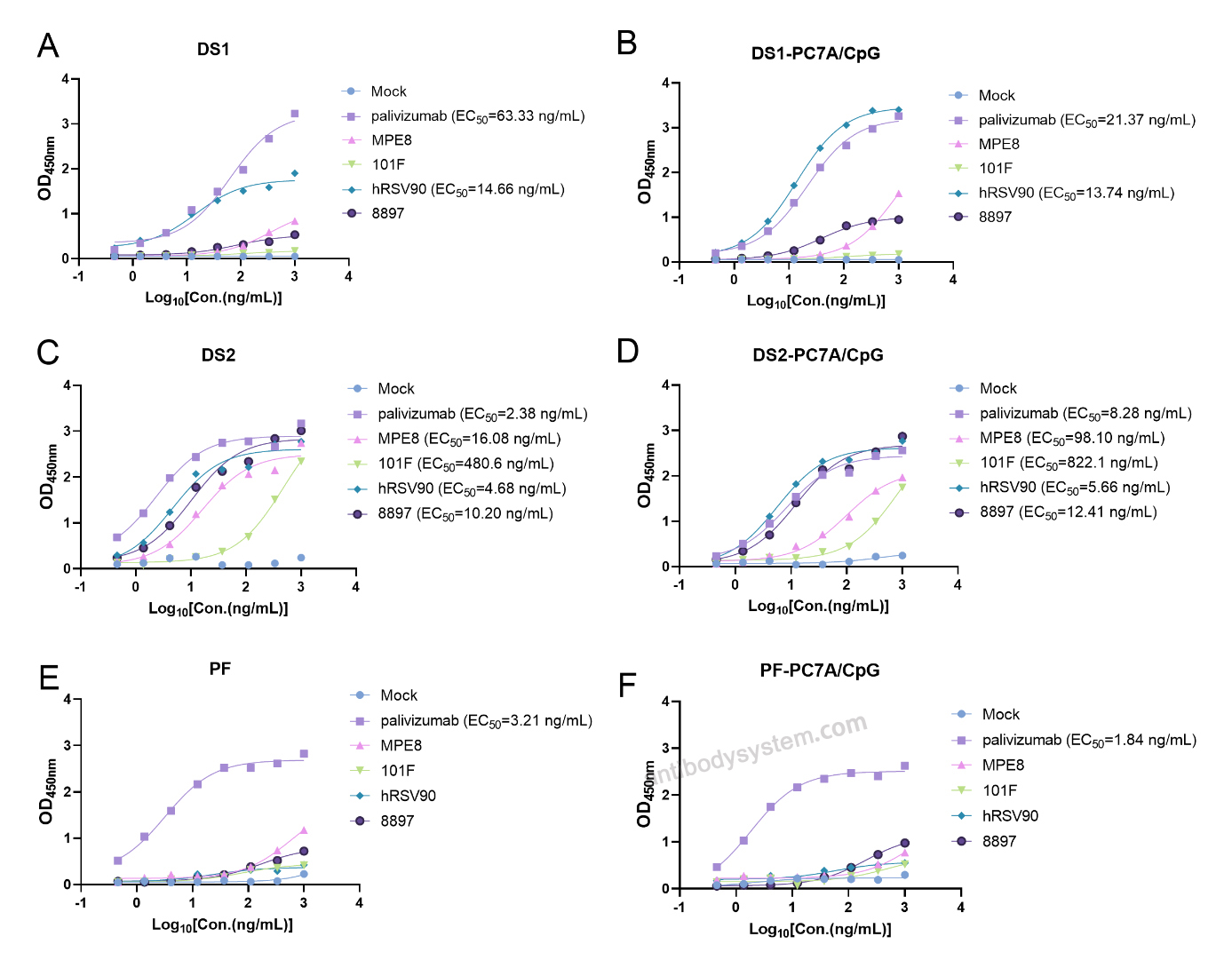
A Self-Assembled RSV-DS2 Based Nanovaccine Elicits a Strong Immune Response Against Respiratory Syncytial Virus Infection. [DVV02801]
[Not Available]., PMID:39586603
[Not Available]., PMID:39586606
The Impact of Palivizumab for Respiratory Syncytial Virus Prophylaxis on Preschool Childhood Asthma., PMID:39591172
Approach to prevention of respiratory syncytial virus disease in infants by passive immunization., PMID:39638376
Trends in endemic of respiratory syncytial virus infection during COVID-19 pandemic and difficulty in obtaining optimal timing of palivizumab prophylaxis., PMID:39667557
Risks and prevention of severe respiratory syncytial virus infection among infants and children with pulmonary hypoplasia, airway stenosis, congenital esophageal atresia, inborn errors of metabolism, or neuromuscular diseases in Japan., PMID:39674346
Use of the moving epidemic method to guide the launch of palivizumab immunization campaigns for respiratory syncytial virus in Québec, Canada., PMID:39702848
Amino acid substitutions in the fusion protein of respiratory syncytial virus in Fukushima, Japan during 2008-2023 and their effects., PMID:39719011
The molecular epidemiology of respiratory syncytial virus in Ontario, Canada from 2022-2024 using a custom whole genome sequencing assay and analytics package., PMID:39721564
Evolving Strategies for Respiratory Syncytial Virus (RSV): A Review Article of Preventive Agents and Vaccines for RSV., PMID:39744803
[Benefits of home-based administration of palivizumab in high-risk groups]., PMID:39760599
Respiratory Syncytial Virus: A WAidid Consensus Document on New Preventive Options., PMID:39771979
Increased Respiratory Syncytial Virus-Associated Hospitalizations and Ambulatory Visits in Very Preterm Infants in the First Year of Life following Discontinuation of Access to Palivizumab., PMID:39788540
The recent landscape of RSV vaccine research., PMID:39802673
Inpatient service utilization amongst infants diagnosed with Respiratory Syncytial Virus infection (RSV) in the United States., PMID:39804848
Investigating the metabolic load of monoclonal antibody production conveyed to an inducible CHO cell line using a transfer-rate online monitoring system., PMID:39828082
An engineered palivizumab IgG2 subclass for synthetic gp130 and fas-mediated signaling., PMID:39828098
Efficacy of a standardized regional palivizumab administration protocol based on epidemic prediction for the following season., PMID:39892510
Economic and clinical burden associated with respiratory syncytial virus and impact of universal immunization with nirsevimab in Italy., PMID:39897385
Early Experience on Universal Prophylaxis in Infants against Respiratory Syncytial Virus: Facts and Expectations., PMID:39900111
Learn from international recommendations and experiences of countries that have successfully implemented monoclonal antibody prophylaxis for prevention of RSV infection., PMID:39905524
Healthcare utilization during acute medically attended episodes of respiratory syncytial virus-related lower respiratory tract infection among infants in the United States., PMID:39928629
Practice recommendations for respiratory syncytial virus prophylaxis among children in Hong Kong., PMID:39957107
Cost-Effectiveness Analysis of Nirsevimab for Preventing Respiratory Syncytial Virus-Related Lower Respiratory Tract Disease in Dutch Infants: An Analysis Including All-Infant Protection., PMID:39976899
Cost-effectiveness of nirsevimab and maternal RSVpreF for preventing respiratory syncytial virus disease in infants across Canada., PMID:39984979
Incidence of and Risk Factors for Subsequent Lower Respiratory Tract Infection Following an Infant RSV Hospitalization., PMID:40003285
Knowledge and Attitudes Regarding Respiratory Syncytial Virus (RSV) Prevention: A Systematic Review., PMID:40006706
Adherence to Palivizumab for Respiratory Syncytial Virus Prophylaxis in Romanian Infants., PMID:40006718
Cost-effectiveness of wastewater and environmental monitoring of respiratory syncytial virus to guide universal infant immunoprophylaxis in Canada., PMID:40019444
Recommendation for immune prophylaxis of respiratory syncytial virus infection in children., PMID:40032543
Respiratory Syncytial Virus Burden in Premature Infants: The Role of Season With and Without RSV Immunoprophylaxis in a Multicenter Study., PMID:40042149
Twenty-five years of palivizumab: a global historic review of its impact on the burden of respiratory syncytial virus disease in children., PMID:40111069
A practical guidance on the prevention and treatment of childhood respiratory syncytial virus infection in Kurdistan., PMID:40151184
Cost-Effectiveness and Public Health Impact of Universal Prophylaxis with Nirsevimab Against Respiratory Syncytial Virus (RSV) Infections in all Infants in Japan., PMID:40153134
RSV Prevention Strategies in Korean Children: A Review of Current Approaches and Emerging Options., PMID:40183652
Health economic evaluation of implementing a universal immunization program with nirsevimab compared to standard of care for the prevention of respiratory syncytial virus disease in Canadian infants., PMID:40186452
Palivizumab coverage rates among moderate-to-late preterm infants in Korea: a nationwide cross-sectional study., PMID:40211817
Optimizing risk factors to guide COST-effective use of palivizumab in KOREAN infants., PMID:40214194
Summary of the National Advisory Committee on Immunization (NACI) Statement on the Prevention of Respiratory Syncytial Virus (RSV) in Infants., PMID:40241712
Palivizumab for the Prophylaxis of Respiratory Syncytial Virus Disease: Expert Opinion and Recommendations for the Gulf Cooperation Council Region., PMID:40248327
Human iPS cell-derived respiratory organoids as a model for respiratory syncytial virus infection., PMID:40262853
Cost-Effectiveness Analysis of Nirsevimab for the Prevention of Respiratory Syncytial Virus among Italian Infants., PMID:40317387
Knowledge, attitudes, and practices of Croatian pediatricians and pediatrics residents about RSV infection., PMID:40328920
Direct Out-of-Pocket Costs of Nirsevimab vs. Palivizumab during the First Respiratory Syncytial Virus Season: A Comparative Analysis., PMID:40343422
The influence of respiratory syncytial virus immunoprophylaxis on allergic sensitisation in children with respiratory allergy., PMID:40360322
Challenges in the prophylaxis of severe respiratory syncytial virus infections., PMID:40373821
Respiratory syncytial virus preventives for children in Australia: current landscape and future directions., PMID:40413643
The potential public health impact of new immunization strategies for the prevention of RSV in children in Panama., PMID:40458968
Turkish pediatricians' knowledge, attitudes, and awareness of respiratory syncytial virus (RSV) infection and immunization strategies: a cross-sectional study., PMID:40466672
Respiratory Syncytial Virus: A Narrative Review of Updates and Recent Advances in Epidemiology, Pathogenesis, Diagnosis, Management and Prevention., PMID:40507642
Palivizumab Prophylaxis Against Respiratory Syncytial Virus Infection in Children with Immunocompromised Conditions or Down Syndrome: A Multicenter, Post-Marketing Surveillance in Japan, PMID: 28895096
The cost effectiveness of palivizumab: a systematic review of the evidence, PMID: 20653398
Palivizumab prophylaxis of respiratory syncytial virus infection in high-risk infants, PMID: 12410864
Role of viral infections in the development and exacerbation of asthma in children, PMID: 28987219
Palivizumab and the prevention of respiratory syncytial virus illness in pediatric patients with congenital heart disease, PMID: 17727335
Revised recommendations concerning palivizumab prophylaxis for respiratory syncytial virus (RSV), PMID: 26670908
Restricted Palivizumab Recommendations and the Impact on RSV Hospitalizations among Infants Born at > 29 Weeks of Gestational Age: An Italian Multicenter Study, PMID: 31238365
Palivizumab in the prophylaxis of respiratory syncytial virus infection, PMID: 16207163
Palivizumab use in infants with Down syndrome-report from the German Synagis™ Registry 2009-2016, PMID: 29651734
A review of cost-effectiveness of palivizumab for respiratory syncytial virus, PMID: 23140255
Palivizumab prophylaxis, respiratory syncytial virus and subsequent development of asthma, PMID: 29795072
Palivizumab administration in preterm infants in France: EPIPAGE-2 cohort study, PMID: 29395887
Palivizumab and prevention of childhood respiratory syncytial viral infection: protocol for a systematic review and meta-analysis of breakthrough infections, PMID: 31340973
Bronchiolitis: an update on management and prophylaxis, PMID: 31059347
The potential impact of palivizumab on pediatric airway reconstruction, PMID: 16360816
Treatment of respiratory syncytial virus with palivizumab: a systematic review, PMID: 21080142
Systematic Review of the Safety and Efficacy of Palivizumab among Infants and Young Children with Cystic Fibrosis, PMID: 28423192
Optimizing Lung Function in Survivors of Preterm Birth: Palivizumab Is Not the Answer, PMID: 32768062
Reducing Palivizumab Dose Requirements Through Rational Dose Regimen Design, PMID: 30426719
A review of palivizumab and emerging therapies for respiratory syncytial virus, PMID: 21831008
Effectiveness of Palivizumab against Respiratory Syncytial Virus: Cohort and Case Series Analysis, PMID: 31378522
Consensus conference on the appropriateness of palivizumab prophylaxis in respiratory syncytial virus disease, PMID: 27618642
Is palivizumab effective as a prophylaxis of respiratory syncytial virus infections in cystic fibrosis patients? A meta-analysis, PMID: 24231153
Palivizumab prophylaxis in 'late preterm' newborns, PMID: 20695756
Administration of Palivizumab in the NICU, PMID: 27164941
Palivizumab for respiratory syncytial virus prophylaxis, PMID: 10690084
Palivizumab Following Extremely Premature Birth Does Not Affect Pulmonary Outcomes in Adolescence, PMID: 32298728
Palivizumab for prophylaxis against respiratory syncytial virus infection in children with cystic fibrosis, PMID: 20166098
Palivizumab for prophylaxis against respiratory syncytial virus infection in children with cystic fibrosis, PMID: 27439110
Universal palivizumab prophylaxis for children with Down syndrome in Japan: analysis with interrupted time-series, PMID: 32961094
Palivizumab for prophylaxis against respiratory syncytial virus infection in children with cystic fibrosis, PMID: 24851825
Palivizumab for prophylaxis against respiratory syncytial virus infection in children with cystic fibrosis, PMID: 22336832
Neutralizing epitopes of RSV and palivizumab resistance in Japan, PMID: 28867684
Initial Palivizumab Dose Administration in Outpatient Clinic After Hospital Discharge, PMID: 29570593
Respiratory Syncytial Virus Bronchiolitis in Children, PMID: 28084708
Palivizumab for prophylaxis against respiratory syncytial virus infection in children with cystic fibrosis, PMID: 23737087
Palivizumab Prophylaxis and Recurrent Wheezing, PMID: 29019698
Adherence and outcomes: a systematic review of palivizumab utilization, PMID: 29130355
Palivizumab's real-world effectiveness: a population-based study in Ontario, Canada, 1993-2017, PMID: 32859612
Palivizumab: an overview, PMID: 10707171
Utilization and efficacy of palivizumab for children with Down syndrome, PMID: 31961027
Palivizumab prophylaxis in preterm infants, PMID: 28219614
Palivizumab and Long-term Outcomes in Cystic Fibrosis, PMID: 31239289
Improving the prescribing of palivizumab, PMID: 29863814
Palivizumab: where to from here?, PMID: 19063700
Product review on the monoclonal antibody palivizumab for prevention of respiratory syncytial virus infection, PMID: 28605249
Palivizumab, PMID: 10473022
Palivizumab, a humanized respiratory syncytial virus monoclonal antibody, reduces hospitalization from respiratory syncytial virus infection in high-risk infants. The IMpact-RSV Study Group, PMID: 9738173
Cost-effectiveness of Palivizumab for Respiratory Syncytial Virus: A Systematic Review, PMID: 31040196
Expert consensus on palivizumab use for respiratory syncytial virus in developed countries, PMID: 31060948

 For research use only. Not for human or drug use.


