
Catalog No.
YHA19001
Expression system
E. coli
Species
Homo sapiens (Human)
Protein length
Ala2-Pro179
Predicted molecular weight
21.83 kDa
Nature
Recombinant
Endotoxin level
Please contact with the lab for this information.
Purity
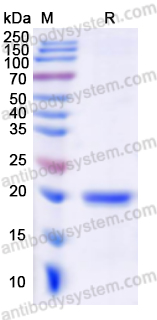
>90% as determined by SDS-PAGE.
Accession
Applications
ELISA, Immunogen, SDS-PAGE, WB, Bioactivity testing in progress
Form
Lyophilized
Storage buffer
Lyophilized from a solution in PBS pH 7.4, 0.02% NLS, 1mM EDTA, 4% Trehalose, 1% Mannitol.
Reconstitution
Reconstitute in sterile water for a stock solution. A copy of datasheet will be provided with the products, please refer to it for details.
Shipping
In general, proteins are provided as lyophilized powder/frozen liquid. They are shipped out with dry ice/blue ice unless customers require otherwise.
Stability and Storage
Use a manual defrost freezer and avoid repeated freeze thaw cycles. Store at 2 to 8°C for frequent use. Store at -20 to -80°C for twelve months from the date of receipt.
Alternative Names
E2 ubiquitin-conjugating enzyme C, UBE2C, Ubiquitin carrier protein C, UbcH10, (E3-independent) E2 ubiquitin-conjugating enzyme C, Ubiquitin-conjugating enzyme E2 C, Ubiquitin-protein ligase C, UBCH10
 For research use only. Not for human or drug use.


